Showing posts with label paris. Show all posts

Saturday, April 14, 2018

Time flies when you have no seasons


The island of Moloka'i, where we visited in March
It's been six months since I last wrote a blog post. We have now lived in Honolulu for eight months, but I have to say, it doesn't feel all that long. The funny thing about Hawaii is that the seasons give you little indication of the passage of time. It was not uncommon for me to think this year, “What a lovely summer day!” and then realize it was February. It's disconcerting. Only the greener color of Diamond Head Crater hints at the presence of winter. Trees seem to flower year round and mid-winter beach trips are the norm, so it's easy to forget what time of year it is. Although the months have slipped by without me hardly noticing, when I reflect on how much my daughter has developed over the last eight months, I realize just how much time has actually passed.

We moved to Honolulu right before Maëlys turned one. She hadn't started walking yet—she was still doing her funny one-legged crawl. She didn't understand most of the words we said to her. I was feeling guilty for not throwing her a first birthday party, but we had no furniture in our apartment and few friends to celebrate with. She didn't mind—she enjoyed opening presents from her relatives, and then lost interest and moved on to something else. She was changing rapidly, but still firmly in the baby category.

Maëlys at 20 months
Now Maëlys is four months shy of being a two-year-old. We're on the verge of starting toilet training with her, she's playing imaginatively with her stuffed animals, she goes to a toddler gym class and can climb, jump, and slide with ease. She can only say a few recognizable words, but she understands and responds appropriately to complex sentences. She teases people, laughs at jokes, and demands back rubs for herself and her toys. Our baby is a baby no more.

In our eight months here, France has also quickly faded into the background. Now, a dream-like fuzziness blurs the edges of my memories of Paris. My French accent sounds atrocious. I have not kept up my French skills as I had wanted to, unfortunately, and it's surprising how quickly my vocabulary has dwindled, only to be replaced by long Hawaiian words that I frequently mix up: Kapahulu, Kaka'ako, Kalawao, Kapiolani. I still keep in touch with a few friends from France, and we send occasional Maëlys photos to our sweet former landlady. But for the most part, our lives have become firmly entrenched in Hawaii and France is now just an anecdote that makes me sound cooler than I really am.

Still, every time I watch a movie set in Paris, my heart skips at the familiarity of the simple things: the blue and green street signs on the corners of buildings, the bright neon vests of the sanitation workers, the sound of the doors-closing alert on the métro. It feels as if I'm still there and need only open a window for the smell of cigarette smoke to waft upwards, for the blaring of car horns and sirens to punctuate the usual low rumble of noise. I miss it. Something which was so frightening and unfamiliar to me for so many months now feels like home. Never mind that in Hawaii I can go to the beach any time I want. Never mind that I can see tons of constellations from my balcony, not just an occasional star or satellite. Never mind that I can breathe clean air and feel safe in my neighborhood. I miss the character of Paris. I miss the feeling of power that comes from crossing a busy street with a throng of other pedestrians. I miss addressing people as monsieur or madame and knowing that I'll hear “Merci, au revoir” when I leave a store.

I'm certain that when I look back on my life, our time in Paris will be two of the best years I ever had. Perhaps two of the hardest as well, but certainly two of the best. That's not to diminish the wonderful new lives we're building for ourselves in Hawaii, of course. I'm constantly in awe of our surroundings--Rory and I get to live in a gorgeous place that most people only dream of visiting, and we both get the chance to work and do what we love while raising an incredible daughter together. Hawaii is full of aloha.

But there's something special about Paris. A certain je ne sais quoi...

Wednesday, October 11, 2017

Shifting Perspectives: Transportation in France and America

America is a car-centered society. We bought a car within a week of moving to Honolulu because we realized how necessary it would be to get around. In our two years of living in Paris, on the other hand, we took less than a dozen car rides, usually in taxis. Very few of the people we knew there owned a car, most preferring simply to walk and take public transit. Parisian public transportation may be grimy and congested at times, but tickets are cheap, service is punctual, and stations are everywhere. With the high cost of fuel and the absurdly expensive and difficult process of acquiring a French driver's license, for many people, public transit makes much more sense than car ownership.

Furthermore, Paris engenders a culture of walking. Everyone walks to the shops, to their dentist appointments, to pick up their children from school. Most neighborhoods have several grocery stores within a ten minute walk—I can think of at least eight near our old apartment. I mentioned in a previous post the three separate free medical clinics for mothers and children in walking distance of our home. I even knew women in Paris who walked home from the hospital after giving birth. With almost every amenity one needs so conveniently located, walking is often the logical choice. It became such a regular part of my daily routine that I thought nothing of spending a few hours on my feet each day, both for getting from place to place but also for enjoyment, exercise, and relaxation.
Maëlys certainly enjoys walking in Hawaii.
So I find it continually surprising how few people I see walking in Honolulu. Here, despite the year-round nice weather, it seems that most people only walk if they have to. For many people, stores, restaurants, medical facilities, and other necessities are too far away to walk to or are inaccessible by public transport. There are often no sidewalks on residential streets, confirming the dominance of vehicles over pedestrians. And while Honolulu has an excellent bus system that covers the whole island, I would bet that a majority of residents have never ridden the bus or have used it only a few times in a given year. Sadly, I must include myself in that category, as I have not yet tried out the bus system (though Rory and Maëlys have made one bus trip so far and it is on my list of things to do).

The funny thing is, it only took two years of living in France to completely change my perspective on the dominance of cars. Before moving to France, I viewed my car as more than just a way to get around town; it was my own private refuge. I enjoyed being in the car, listening to the radio. And if I had to walk for more than five minutes to get somewhere, I would usually just hop in the car instead. I don't think I was particularly lazy, nor was I unconcerned with the environmental impact of driving. But my perception of what was an acceptable walking distance was skewed. I had no sense of how far away places were except in terms of driving time, so walking typically felt like an unnecessary and inefficient use of my time.

After living in Paris, I now much prefer to walk rather than drive. The fact that a place is far enough away that I must drive to get there is now a deterrent for me going there. But alas, my options here are limited when it comes to stores, restaurants, medical facilities, and schools that are within walking distance of home, so I feel myself being pulled back into the habit of driving that I so easily gave up in Paris. Honolulu does have buses and a new bike sharing program, but service is relatively limited, and the convenience factor is far less than simply jumping in a car. So for now, to combat the influences of America's ever-present car culture, I'm trying to patronize the few stores that are located near our home (walking there, of course), take daily walks around our neighborhood, and avoid unnecessary trips in the car. And one of these days, I'll have to try out the bus.

Tuesday, June 27, 2017

Monday, April 3, 2017

Château de malmaison

Two weeks ago, March 20th, was Naw-Ruz, the Baha'i New Year. I took the day off work and we decided to go on a short day trip to welcome in the new year. The weather was pleasant -- bright but cloudy, dry and reasonably warm. It was a welcome change from winter.
The château de malmaison.
We settled on visiting the Château de Malmaison, the former residence of Empress Josephine, Napoleon's first wife. This is in the suburb Rueil-Malmaison, a short train or bus ride west of Paris.

If you know some French, you probably realized that "Malmaison" sounds like "bad house": mal means bad or wrong (like in the English words maladjusted and malnutrition), and maison means house. Sometimes when you see curious expressions like this in place names, it's actually a coincidence, and the name originates with some other words, perhaps words which are now archaic or forgotten, or even from a different language. For example, the names of the English towns of Puddletown and Catbrain are actually derived from Middle English phrases meaning "farmstead on the marsh" and "soil mixed with clay and stones", respectively.

In the case of Malmaison, however, it really does have the meaning we think. In 846, a mansion in this area was burned to the ground by Viking invaders. The area was then dubbed malmaison, meaning "mansion of back luck". Looks like the name stuck!

On the way to the chateau, we bumped into the parc de l'amitié, the park of friendship, a local park with some Japanese gardens, a rose garden, and some other features. Given the name and the Japanese theme, I thought that perhaps it was a garden of international friendship -- perhaps the results of the town being twinned with somewhere in Japan, or something like that. But I was unable to find any evidence of that. As far as I can tell, the city planners just wanted to build a cool park. That's okay with me!

The Japanese garden featured a pond and a scenic bridge. And blossoms, lots of blossoms.
In the grounds of the chateau itself is an art collection of Daniel Iffla, a 19th-Century French financier and philanthropist who named himself Osiris (yes, the same name as the Egyptian god). It was a modest collection of various objets d'art from various cultures around the world -- China, Persia, Greece, Rome. It was also really dark inside (presumably to protect the art), and quiet. It doubled as a good place to quickly change and feed Maëlys, too.
Osiris himself!
It was lunchtime when we arrived, and the chateau closes for lunch! The gardens were still open, however, so that afforded us some time to enjoy our own lunch (we'd packed a little picnic) and look around. The gardens are home to a large rose garden, not in bloom at the time of our visit, and several statues and little streams dot the area. Attempts have been made to have the garden resemble how it was at the time of Empress Josephine, although in her day the gardens extended much further in all directions. Josephine grew up in Martinique, in the Caribbean, and so apparently having a well-tended, diverse garden was a particular source of joy for her. There used to be a greenhouse where she grew pineapples!

One of the garden paths, with the chateau in the distance.

As you can see in the picture at the beginning of this post, it is a nice building, but not particularly grand. That is, it is an excellent example of a stately home, but if you had asked me to guess who lived inside, I would not have imagined "empress". The reason for that is because Josephine purchased the mansion way back when Napoleon was just a general, busy invading Egypt. When Napoleon returned, apparently he was upset at her for purchasing such a run-down mansion that would require so much work to renovate! He didn't have much time to be angry, however, as he was busy planning a coup d'état to overthrow the unpopular government and install himself as emperor. They divorced in 1810 following acrimonious disputes about affairs and Josephine's infertility, although she remained Empress.

Anyway, the inside of the chateau was decked out as it was at the time of Josephine. There were lots of grand paintings, intricate timepieces, and fancy chairs. Absent was any kitchen or obvious servant's quarters, but apparently they were in other buildings in the grounds which have since been destroyed.

One of the receiving rooms inside the chateau.
There was a lot of Napoleon-themed pieces around, including the original version of the famous painting Napoleon Crosses the Alps, which depicts (in grand heroic style) Napoleon heading from France into Italy in 1800. Not pictured: his army!

Napoleon Crosses the Alps!
After we'd seen around the chateau, we hopped back on a bus and then a train and made our way home. It was a lovely trip outside of Paris for the day, and we're going to try to do more day trips like this as our move to Hawai'i gets closer and closer! As I looking back on the pictures from the chateau, it all looks a little drab and grey in comparison to the weather we've had here in the last week or so. It appears that we did a good job of welcoming in the spring!

Sunday, July 24, 2016

Preparing for Bébé, Part 3


Welcome to this week's installment of Preparing for Bébé. For those who are keeping track, I am now on Week 39 of pregnancy, and my day-to-day living can be summed up neatly in this picture. I'm pretty sure I've said the words “bladder” and “I need to pee” (or comically in French: j'ai envie de faire pipi) more in the last couple of weeks than in the entire rest of my life. At our last appointment, our midwife described the baby's head as being très, très bas” (very, very low) in my pelvis, which is great for birth but a tad annoying in the immediate. Nevertheless, I'm feeling upbeat and optimistic, doing lots of walking, and baking double batches of chocolate chip muffins – just in case.

So for our final baby preparation blog post, I thought I would share our experiences with economizing on space in readying our apartment for the baby.

If you live or have lived in a large metropolis like Paris, you may be familiar with the concept of tiny accommodations. I, however, was not. I was used to relatively large houses with a garage, front and back yards, and plenty of personal space. Even when I went off to university and lived in a variety of cheap student apartments, there were always distinctly separate rooms and typically more space than I needed.

Coming to Paris, however, I quickly learned that space is at a premium. We have two friends who recently celebrated their move from one apartment to another one that was five times as big. Yes, they went from a whopping 7 m2 (smaller than an average US bedroom) to a spacious 35 m2 (75 ft2 to 376 ft2). It made me realize what a luxury it is to have lots of room.

Our current apartment is 33 m2 (355 ft2) and comprises a combination kitchen – living room – dining room area, plus a bedroom with an en suite bathroom. When I was reading about what furniture we would need for a baby, I kept finding pictures of immaculate nurseries that were bigger than half of our apartment. While this was somewhat disheartening, it also felt like a relief that we would not have to spend hours “designing the perfect nursery” and buy tons of furniture to decorate it with. Instead, we have had a fun time puzzling over how to fit everything into our limited space.

Puzzle #1: The crib
For example, we knew the baby's crib would need to go towards the foot of the bed in our bedroom as there was no other space big enough for it. However, most cribs on the market have dimensions that would have blocked our access to the bathroom, which would be a disaster for me in my current state of walnut-sized bladder. After weeks of searching, we thought we had settled on a smaller foldable crib that would only partially block our toilet access, but then realized it would only work for the first six months of the baby's life before it would be outgrown and we'd need a bigger crib. Back to the drawing board.

Message Classifieds to the rescue! Fortunately, I found a parent advertising a used Bloom Alma Mini crib, a fancy pants solid wood crib that is foldable and sized for “urban living spaces” with “room-to-room mobility during nap time.” Amazingly, the dimensions were perfect to slide into the nook next to our bedroom wardrobe, thus leaving plenty of space to get to the bathroom. It has an adjustable mattress height too, so it can last at least the baby's first 12 months. Hallelujah! Plus, we got it for less than half the original price. 


Puzzle #2: The changing station
If we could barely fit a crib in our bedroom, imagine trying to fit a typical diaper changing table in there too. We racked our brains to come up with a place for one and spent hours searching for small tables online, but ultimately found nothing. The solution?

The washing machine! We have a front-loading washer squeezed into our bathroom next to the sink, which happens to be at a great height for changing a baby. Just plop a contoured changing mat on top, and voilà! Of course, it wasn't quite that simple. Changing mats basically seem to come in one size, and, you guessed it! the size is bigger than our space would allow. Out of hundreds of varieties, I found only three that would sort of fit on our washing machine and none of them looked like great products. My energy spent, I enlisted Rory to continue the search in the more remote areas of the internet. Having almost given up, he finally stumbled upon a Danish product (BabyDan) on an Irish baby safety website that fit our dimensions to a T. What a relief! It may not be the most spacious baby changing area ever, but it should suffice.

Puzzle #3: Expectations vs reality
How do we fit a rocking chair in here? Where do we keep the stroller so it's not invading the whole living room? If we get a food processor/blender, where can we possibly store it? These are the other kinds of small living space questions we've been grappling with. Before coming to Paris, I now realize I had a lot of expectations about what constitutes a home, especially a home with two tax-paying grown-ups and a baby inside it. Years of subconscious media absorption led me to believe that a rocking chair was an absolutely essential element for nursing mothers. And I would have been fairly scandalized at the idea of storing kitchen appliances in the living room. These are very silly, trivial issues, especially in light of the massive problems facing the world today, but they have shown me how rigid my ideas have become on even some of the most frivolous of topics. Thank god for eye-opening experiences like moving to a new country.

As it turns out, rocking chairs are not mandatory for nursing mothers. They're not even that common in France. We opted to fill that space in our living room instead with a foldable dining table so that we could invite friends and family over for meals (there was previously only dining space for Rory and me). The food processor fits beautifully in our bookcase next to the baby books—why shouldn't it? And the folded stroller has found a home in a corner of the living room.

Sometimes the biggest puzzle in preparing for a baby is simply learning how to let go of your expectations. Most of us have developed beliefs over many years about the right way to do things. In coming to France, I've been reminded over and over that there are many right ways to live, to raise children, to furnish a home, to be successful, to be happy, and that our limited experience as humans can't possibly give us the omniscience to know the single best way to be. So try new things. Turn off that judgy voice in your head when you see something that doesn't conform to your expectations. Because really, we all just have the same goal. In the words of Tim Gunn, we have to “Make it work!”

Sunday, July 17, 2016

La fête nationale

Thursday, the 14th of July, was France's fête nationale, usually known in English as "Bastille day". This is France's big national holiday, with a big display of patriotism, similar to America's Fourth of July.
The "blue, white and red" of the French flag, courtesy of the airforce. (The middle stream looks grey, but that's just because this picture was taken looking into the sun.)
Most English-speaking sources that talk about Bastille day mention that it commemorates the storming of the Bastille (14th July, 1789). This event, as it is told, was when the common people of Paris spontaneously rose up, stormed a huge medieval fortress (the Bastille), and freed the political prisoners inside, in a display of their desire for liberty against a tyrannical monarchy.

Some guys on horses.
Imagine my surprise to learn that the fête nationale does not (solely) commemorate the fall of the Bastille, and that the fall of the Bastille had nothing to do with political prisoners! In the late 1780s, France was going through a crisis - plainly, the country was broke, and the systems of government were over-complex and not conducive to economic growth. Cutting a long story short, the common people were upset at having limited representation in the ongoing negotiations to solve the crisis, and for various reasons (some true and some untrue) they believed that the king was going to lead a militaristic crackdown on the people of Paris. So, they stormed a military storehouse to gather weapons, but there was no gunpowder or shot. The closest place that had gunpowder? The Bastille! This then led to an armed standoff between the military governor who was in charge of the Bastille, and the mob of angry Parisians outside of it, who were armed but with no ammunition. Eventually the mob won, and the French revolution sort of snowballed from there.

Shiny helmets and swords.

One year later, on 14 July 1790, the French government held la fête de la federation, to commemorate the events of the fall of the Bastille in a show of national unity and solidarity. This event came during a time of relative calm; a constitutional monarchy was in place, with the king presiding over a (somewhat) democratically elected representative government. Feudalism was abolished, outdated judicial structures reformed, and things looked good. This historical event is also what the modern-day fête nationale celebrates. (Of course, as we know, everything was not fine in 1790, and the revolution would proceed with the overthrow of the royal family, radical dechristianization of the country, the reign of terror, several wars in Europe and the Caribbean, and the establishment of a republic with many freedoms previously thought impossible.)

So, that's what the day celebrates, more or less. The end of the ancien régime and the founding of the modern French state, with its principles of liberté, egalité, fraternité (freedom, equality, brotherhood). Every year along the Champs-Elysées there is a big défilé militaire (military parade).
Crowds assembled along the Champs-Elysées to see the military parade.

We decided to brave the crowds to see the parade. There were many people on foot from many different divisions of the armed forces (including the gendarmes and firefighters!), some on horseback, and a lot of vehicles. Motorbikes, jeeps, tanks, amphibious vehicles, artillery guns, diggers, engineering stations, and even a few drone launchers. Then there were many planes and helicopters that flew overhead. Apparently the president also makes an appearance, although we must have missed him.
A tank rolls down the Champs-Elysées.
In the evening, there was a big concert at the Champs de Mars (in front of the Eiffel Tower), followed by fireworks. We'd had enough of standing in large crowds by this point, and so we decided to watch it streaming online instead. It was quite different from either an American Fourth of July "pops concert" or a British last night of the Proms, two equivalently patriotic music events. You can see the whole concert here, mostly music from French composers but not entirely, finishing, of course, with La Marseilleise, the French national anthem. The fireworks were launched from the Eiffel Tower, which gives a lot of artistic options that you don't have from a ground launch (such as firing sideways). Rather than being bombastic and awesome (the "shock and awe" approach of American fireworks) this firework display was more beautiful and aesthetically appealing. You can view it here.

It was only the following morning that we heard of the terrible attack that had taken place in Nice. Committing mass murder on a day that is dedicated to celebrating freedom, equality, and brotherhood is one of the more repugnant acts I can imagine, but what better way to respond than to reaffirm those values, to stand firm in courage against those who would seek to divide us? The Paris revolutionaries of 1789 would stand for no less.

Sunday, July 10, 2016

Preparing for Bébé, Part 2

In Part 1 of Preparing for Bébé, I mentioned some of the activities we've undertaken in the final stretch of my pregnancy. And in previous posts, I shared some of my experiences with things like health care and public transportation as a pregnant woman in France. By the way, good news on the transportation front! Once I hit about 8 months, my belly had become sufficiently large that people started regularly giving me their seat on the bus and métro. No more of the "I don't want to offend her by assuming she's pregnant if she's really not" behavior. It's been great! I really appreciate the Parisians' courtesy and generosity in this regard. The one caveat is that when people are engrossed in their phones (as most people are these days), it's much less likely they will notice my protruding tummy and I'll have to stand until a seat opens up. Such is life with technology these days.

Excusez-moi? Heavily pregnant lady would like to sit down. Anyone home?
Anyway, in today's blog, Part 2 of Preparing for Bébé, I'll look at two of the most helpful tools I've found that have allowed us to get ready for the baby. These are specific to living as an ex-pat in Paris, but provide a good contrast to the preparation process in the US or UK.

Message: like a bridge over troubled waters

The first crucial element in our quest to be well-prepared parents has been membership in Message, the large community of English-speaking parents and parents-to-be in Paris and its suburbs. I learned about Message from a blog post back in December when I was feverishly researching how to have a baby in France. Remember that my French language skills were pretty limited back then, so diving into French administrative websites for information on finding doctors, paying for health care, and registering at maternity hospitals was hugely overwhelming. Add on the early pregnancy hormones and anxiety, and I was barely keeping my head above water. When I found Message, I felt I had been saved.

Upon paying my 60 € membership fee, I received a very helpful book called The ABCs of Parenting in Paris, which explained everything from declaring one's pregnancy to government agencies to what types of butter are available in Paris grocery stores. More importantly, I was personally contacted by coordinating members of Message who answered my panicked questions and suggested I explore the online Message forums, where one can find a rabbit hole of members' questions and answers on any subject regarding the ex-pat parent's experience. It was a treasure trove of knowledge. Through these forums, I found an excellent English-speaking obstetrician, learned which hospitals not to go to, and got step-by-step instructions on submitting my pregnancy declaration to the government.

In addition to the online forums, Message offers classes led by trained volunteers on topics like birth preparation, newborn care, and breastfeeding. The classes were super helpful for Rory and me, and not just because they weren't in French (though that was a big part of it!) Another nice perk is that each Message member gets an assigned Breastfeeding Support Person who will help and advise you (for free!) with any questions or problems related to breastfeeding. Furthermore, there are Message play groups, monthly meet-ups, bring-and-buy sales, and seminars, as well as support groups for single parents, adopting parents, and more.

One of the most useful features of Message for us, however, has been its online Classifieds forum. Like Craigslist or France's version, Le Bon Coin, members can freely post their items for sale, apartments for rent, services offered, or items wanted, but you get to avoid the scams and shady characters common to Craigslist and don't have to contact people in French like on Le Bon Coin. Instead, it's just buying from one ex-pat mom or dad to another. The prices are often excellent and you can find gently used high quality (e.g. typically very expensive when new) baby gear. Plus, you get to meet friendly parents around the city who were in your shoes not too long ago and who can give helpful advice. It has been an invaluable service.

Membership in Message has already paid for itself many times over. When having a baby in a foreign country, especially when far away from family, anything that makes you feel less adrift at sea is probably worth doing.

The fact that Paris is a big enough city for a well-organized network like Message to exist, is also part of what makes living here a challenge. This city is expensive. This brings us to the second crucial element of our baby preparation: how to save money on baby stuff in a city where an apartment the size of a closet can sell for 200,000 €.

Saving money: go used and go online

Truth #1: Living in Paris is expensive. Although many ex-pats who move here work for big global corporations and can afford to live in the shadow of the Eiffel Tower, we are not those ex-pats. Rory's two-year university contract and my very part-time music teaching keep us afloat and fairly comfortable, but the cost of living is just a smidge higher than we were used to in Ohio.

Truth #2: Having a baby is expensive. Holy catfish, Batman! Baby stuff is NOT cheap! 800 € for a stroller? 600 € for a crib? Well, there goes our month's rent...

With a first baby, there's often this desire to have brand new everything for one's precious bundle of joy. It has to be pristine! It has to be the best! I, too, had these feelings briefly.

But then I remembered that we most likely only have one year left in Paris, and international moving/shipping costs are enormous, so investing in brand new furniture and baby gear doesn't make sense as we may not even take it all with us when we move. That's where the Message Classifieds came in. The vast majority of our large baby-related purchases have come second-hand from Message members. Crib, stroller, swing, playmat, even dining room table and food processor were pre-loved by Message members. Had we bought everything new that we found on Message, it would have cost us in the neighborhood of 2100 €. Instead it cost us 595 €. It required patiently browsing through Classifieds posts every few days and making long trips out to the corners of Paris to pick items up, but the savings were definitely worth it.

Online shopping has been another huge money and time saver for us in Paris. Here's why.

As I was explaining to my incredulous mother the other day, there really aren't any big one-stop-shopping stores in our neck of the woods. Nothing like Target, Costco, or Walmart exists over here. You can find select places like Monoprix—a stand-alone department store that has groceries, clothes, and limited home goods, but the selection isn't very big by American standards and they're on the expensive side. So generally if I need to buy a wide variety of products, I have to go to a wide variety of stores. As I have no car, I have to walk or take the bus or subway to do my shopping. My 9-months-pregnant body can't handle too much of that these days, so that's strike one against traditional shopping.

Fill-your-car shopping trips and the stockpiling of groceries for the month aren't really done here either. In France, every few days you go to the boulangerie to buy bread, the boucherie to buy meat, the fromagerie to buy cheese, and it lasts for a few days or a week. Refrigerators and freezers are small, apartments are small, and we haven't had a pantry or closet since we lived in the US. You don't pick up 12-packs of butter at Costco because you won't have room to store it. Besides, again, I have no car, so I can't buy more than I can carry. I even gave in last month and bought what I call a Granny Shopping Cart, but I still can't bring that much stuff home at one time. Babies apparently need and consume a lot of random stuff, and heaven forbid if you should run out of diapers, or if the batteries for the baby swing die in the middle of the night. Or on a Sunday, when all of the stores here are closed. Going out shopping with a screaming baby every other day is probably not high on most parents' list of things to do, so that's strike two against traditional shopping.

Hence, online shopping.

After weeks of research on Amazon, bebe-au-naturel.com, lilinappy.fr, and dozens of other websites, after slowly reading and translating French product reviews and comparing prices in France, the US, and the UK, we ended up buying more than 300 € worth of baby-related stuff online (think wipes, baby laundry detergent, waterproof mattress pad, nasal aspirator, cloth diapering accessories, etc.) and had it shipped to our door (or to a nearby location for pick-up). It did mean dealing with unintelligible delivery-guy phone calls in French, but was otherwise an easy and straightforward way to ensure we got highly recommended products at cheaper prices. And I didn't have to kill my back and feet running around to dozens of stores throughout Paris to do it. I call that a win.

That's all for Part 2 of Preparing for Bébé. In our final installment, I'll show you how we are turning our little 33 sq. m (355 sq. ft) apartment into a baby-ready home without feeling like we're on an episode of Hoarders.

Have a splendid week, everyone!

Thursday, June 30, 2016

La fête de la musique

The 21st of June was la fête de la musique, which is also called "Make Music Day". All day (although especially in the evening), people of Paris come out onto the streets and play music, listen to music, and dance. There are organized events (for free), with professional musicians playing their most well-known pieces, and there are spontaneous expressions, with groups of plucky amateurs testing out their latest improvisation. It's quite something.

June the 21st is also around the time of the summer solstice, the longest day. This year, the sun rose at 5:47am and set at 9:58pm, giving us 16 hours and 10 minutes of daytime. This long day is ideal for an evening of wandering the streets and enjoying music late into the night!

If you're reading this in the USA, a 16-hour day probably seems pretty long. Only in the northernmost edges of the continental US do you get days even approaching 16 hours. On the other hand, if you're reading this in Scotland, you're probably wondering what the big deal is - Paris's longest day was more than an hour shorter than Glasgow's longest day, and the Shetland islands enjoy nearly 19 hours on the same day. Most of Scotland won't see days as short as 16 hours until early August. And if you're reading this from somewhere else, then hello! Nice of you to join us.

So, as I mentioned, there were many many musical events happening all over the city, some publicized, some not. There was a tremendous diversity of music on offer - from smooth jazz to punk rock to electro-swing. We decided to go to a little concert which was being held in the courtyard of the Mémorial de la Shoah (Holocaust Memorial Museum). It featured an eclectic classical string group with two violins, one viola, two cellos, a bass, and a harp! Also performing was a teenaged a cappella choir who sung vocal versions of pop songs. They took turns performing throughout the evening.
Our view of the string performers.
I'll leave a full critique of the music to Talia, but I certainly enjoyed it and it was clear that the performers were all really enjoying themselves. It is really special that there's a whole day set aside for people to just enjoy music. And looking at the publicized events, there was a real diversity on offer. If you wanted to go and see the Orchestre de Paris play a Mahler symphony, you could do that; if you wanted to go to a rave, there was that; if you wanted to enjoy some traditional Portuguese fishing songs, then you could even do that. And of course, just around the corner there is an old crooner singing the Beatle's Come Together in a thick French accent. What a way to celebrate the summer solstice!

Tuesday, June 14, 2016

Bike helmets

As we mentioned in our last post, I was in the Netherlands recently. I enjoy visiting the Netherlands, and one of the reasons is that I get to marvel at the bicycle infrastructure there, where towns are organized on the understanding that cycling is the most popular mode of transport, with cars an afterthought.

And so in my brief time there, I saw hundreds of people cycling. Old people, young people, children, teenagers. Cycling to work, cycling home, cycling to the supermarket, cycling for fun. Cycling fast, cycling slow, cycling on tandems, cycling alone. Yet in all this diversity of cyclitude, one thing was constant:

No-one was wearing a helmet.

Dutch people cycling near the Nijmegen train station without any helmets. The nutters!
How shocking you find this will probably depend to a large part on where you're from. Of course, the Dutch find it quite normal. In Paris, helmets are not common, but maybe 10% of cyclists wear them (myself included). At the opposite extreme, there are places like Sydney, and a number of American cities, it is illegal not to wear a helmet.

Surely, then, the gentle Australians are much safer on the roads, with their mandatory helmet, than the harried Parisian (or Amsterdammer) who braves the busy city streets sans un casque (with no helmet)?

As it turns out, places that have mandatory helmet laws tend to have more bicycle accidents than places with no such laws.

Still, perhaps that's why they have the laws? As you can see in the picture above, in the Netherlands there are huge dedicated cycle lanes, separated from motor traffic. Perhaps the Sydney traffic is just so terrible - and the bike infrastructure so meagre - that biking is inherently super-dangerous and the helmet law is actually protecting people. Without the helmet law, the cycling accidents would be even more severe.

The counter-argument to this took me a while to understand, but it's the common refrain when you ask Dutch people (and many others) about why mandatory helmet laws are a bad idea. It begins with the principle that cycling is good. Cycling, as exercise, is good for your health. (If you're in an accident, it can be very bad for your health, and we'll address that later.) Cycling is also good for the public at large - if someone chooses to cycle, generally they're choosing not to drive. So each cyclist on the road means one fewer car on the road - this alleviates traffic. It's also good for the environment - one fewer car on the road means less air pollution.

So, from the point of view of maximizing the social good, cycling should be encouraged, and we should make bike-friendly policies. This includes bike lanes, subsidies for bike purchases or rentals, and more bike parking spots.

From this perspective, mandatory helmet laws discourage cycling, as it puts up a barrier to cycling. Forgot your helmet at home? Oh, you can't cycle. Don't have a helmet for a visiting friend? Oh, you can't cycle. This problem is especially amplified for bike-share systems like the one in Paris I have blogged about before. In Paris, you can just hop on a bike and nip down to the post office or wherever without a care in the world. In Sydney, you need to bring a helmet with you. (This may be part of why the Sydney bike share system is relatively unsuccessful.) Such a law also puts a burden on families, who need to buy new helmets every so often for their growing children.

I read a report from a Dutch advisory body (I would link to it, but I've forgotten where I saw it, and it's in Dutch...) which concluded that yes, there are some injuries that could have been avoided by wearing a helmet, but that the overall public health benefits of people cycling outweighed those injuries. Exercising is good and accompanied by a small risk, but the net outcome was a positive one for society in general. An extreme analogy would be that going to school is risky, because you could get hit by a bus and die, but the benefits of going to school and being educated outweigh the risk of dying by bus. The cold Dutch calculus concluded that helmet laws are unnecessary.

There are other problems with mandatory helmet laws. There is concern about how effective they actually are. I would wager that maybe 5-10% of the helmets I've seen worn in Paris were actually being worn incorrectly - not tight enough, pushed too far back on the head, and so on. A helmet only protects part of your head, not your jaw, or your torso, or many other vital body parts.

And then there's the psychology. There is evidence to suggest that wearing a helmet makes people feel safe, which is a problem because that encourages them to do more risky behaviour. Not just the cyclists - there have even been suggestions that motorists drive much more closely to cyclists wearing helmets than to those without. I know that I feel "naked" when I cycle without my helmet, and I wonder if that means that I take more risks when I am helmeted than when I am not - thereby increasing my chance of an accident. That's not what helmets are supposed to do!

Finally, I've heard philosophical arguments against helmet laws. Such laws put the onus of safety and protection on the cyclist, rather than on the system as a whole. Rather than asking cyclists to "be safe", why don't we work to make the environment safe? As I mentioned the biking infrastructure in the Netherlands is very advanced and helpful for safe cycling, quite unlike many US cities. (Still, a helmet law is cheaper and easier to enact than sweeping infrastructure changes...)

So what do I do? I wear a helmet when I cycle. I want to protect my brain, above all, since that's quite a useful organ for a professional researcher to have fully intact. Hopefully the helmet would protect me in case I have an accident; or perhaps it encourages risky behaviour from me and motorists around me? I'm not sure. Still, I don't think that a law mandating helmet use is a particularly useful piece of the puzzle in encouraging cycling. I'm glad to have the choice, and to be able to forget my helmet from time to time.

Tuesday, May 31, 2016

Visitors, Trips, Birthing Classes, and Immigration Woes

We are rather falling behind in our writing of blog posts. Sorry, dear readers! As the end of my pregnancy draws nearer, it seems there are a plethora of tasks as well as hours of research begging to be done. But we will do our best to keep up with the updates. Here are some of the things we've been busy with recently.

First of all, last weekend we had a lovely quick visit with Micah, another dear friend from Columbus. Micah happens to be the younger brother of Soraya, who we saw in London in April. Just four more people to go and we will have been visited by their whole family! Micah, who is studying history at Ohio State University, was part of a school tour of European historical sites. He visited Ireland, England, France, Poland, and Germany, and we were lucky to get to take him out to dinner before he left Paris. We sampled the delicious, if not-so-French, cuisine of Loulou's Friendly Diner (excellent burgers and gluten free buns too!), walked around the Saint Germain des Prés area of Paris (the Middle Ages Museum is cool--it features a Roman-era bathhouse), and walked up to the Panthéon, the huge domed secular mausoleum where notable French citizens are buried. Then naturally we found a fancy chocolaterie, Maison Georges Larnicol, where we oohed and ahhed and Micah bought some treats to take back with him. It's always wonderful to see friends from our old home!

Micah came to visit!
We also spent about 16 hours that same weekend taking a childbirthing and newborn care class that was put on by and for the English-speaking members of Message, a group for anglophone parents in Paris. I will write a post soon with more information about Message, as it's been a lifesaver for us in navigating pregnancy in France. But for now, I'll say that the birthing class was excellent! It was attended by five couples from American, English, Scottish, French, and German backgrounds, and was taught by a lovely and knowledgable English lady who received training from the UK's National Childbirth Trust. It was a great opportunity to meet others in the same boat as us, trying to navigate the confusing waters of grossesse en France. We learned a lot, shared our experiences, hopes, and fears, and made some friends and supporters in the process.

Last week, Rory was finally able to make his re-scheduled trip to the Netherlands. He had been invited to give a presentation at the Max Planck Institute for Psycholinguistics in Nijmegen back in March, but with the Brussels terrorist attacks happening the day he was meant to leave, his train was cancelled. This time he made it to the Netherlands without incident and enjoyed presenting his research to a group of linguists. Afterwards, he spent a few hours wandering around Amsterdam, being impressed by the half-moon-shaped belts of canals and the huge number of bicycles on the streets.
Canals of Amsterdam

On a less exciting note, I had my long-awaited convocation at the police prefecture for my carte de séjour (my French residence permit). I'd waited for this since my last appointment in January, and at this appointment I should have, in theory, been given the green light to actually receive the real permit in about a month or so. However, we moved to a new flat in a département (an administrative district in France; bigger than a county but smaller than a state) outside of Paris in the intervening months. Since cartes de séjour are handled by each département separately, the best they could do for us was to renew my récépissé for a month (a receipt which allows me to live in France for a couple of months at a time), and tell me to make an appointment at the prefecture in my new département. I suspect the process (ongoing for the last 7 months) will have to be started again almost from scratch at the new place, so I'm not overjoyed about this development. C'est la vie française. 

More soon to come! Have a great week, everyone!

Sunday, May 8, 2016

Pregnant in Paris, Part 2

28 weeks along with our new poussette
A lot has changed since I last wrote about my experiences of being pregnant in Paris. For one thing, I was considerably smaller back then. Now our beginning-of-third-trimester baby is packing on the pounds and so am I. Despite what feels like a hugely noticeable change in my body, I still get comments from people to the effect of, "You're barely showing!" Keep in mind, dear friends, that whether you say, "You're huge!" or "You're so tiny!" to a pregnant woman, it's probably the opposite of what she wants to hear. You've been warned.

I've heard from others moms in Paris that France is the place to be if you're pregnant. There are special check-out lanes for you at supermarkets, you can cut to the front of the line in many situations, people are supposed to give you their seat on the bus or subway, and you're just generally treated like a rock star. Plus, once you actually have the baby, French men in particular seem to have been trained to help mothers with strollers whenever needed, such as carrying the stroller down the stairs to the metro station. There is apparently a lot of kindness and consideration here for those who are gestating.

But I haven't really experienced it yet. Not much, anyway. The one time I was offered a seat on the metro was when Rory was very obviously rubbing my protruding tummy. I've seen it happen to other pregnant women though, so maybe the perks will start coming when I've gained a few more inches in girth. And as for the special lanes in stores, or people letting you go first, well, those special lanes are usually clogged with normal-appearing people, and no one has yet offered to let me skip a queue. But we shall see.

The healthcare puzzle

In my last pregnancy post I mentioned the French health care system, or what little we understood of it at the time. I think I have a better handle on it now, though figuring out the sécurité sociale (how one is reimbursed by the government for healthcare expenses) and what to do in case of grossesse (pregnancy) has been more challenging than I anticipated. It's rather like being told to put together a jigsaw puzzle for which you have been given only half of the pieces and no final picture to aim for. You have to find the remaining pieces by yourself with no instruction on where to look. Oh, and by the way, it's a 5000-piece Impressionist painting jigsaw puzzle. Bonne chance!

Briefly, the hunt to acquire a social security number for myself has gone something like this.
-Learn that I can be attached to Rory's social security number. Rejoice!
-Learn that I can't be attached to Rory's social security number. Despair!
-Call an English helpline and be told to fill out a form, put together a dossier, then go to a CPAM office to ask for a social security number.
-Get to the CPAM office and be told to mail them the dossier instead and wait two months for a response.
-Proceed to wait, hearing nothing, while still paying for monthly doctor's and medical lab visits out-of-pocket.

The plot thickens...
Meanwhile, around February, I registered for auto-entrepreneur status (translation: self-employment) for the teaching work I've been doing. I received complex documents in French regarding paying taxes on my business earnings, but no concrete steps on how to do so or on how to obtain healthcare coverage with this status. Suddenly! I received a letter saying I had been registered with the RSI, the social security/healthcare coverage organization for auto-entrepreneurs. The what?? I had no idea this even existed. And voilà! Just like that they gave me a social security number! Had I not become an auto-entrepreneur, I suspect I would still be waiting for my number and going back and forth with the CPAM office.

Now that I'm finally in the social security system, one might think it would be straightforward from here on out. Alas, this is France.

So shortly after this revelation happened, I spent three weeks in the US and we moved to a new apartment just outside Paris. Thus, I received no more letters or instructions and couldn't access any online systems to update my address. With varying success, I tried to contact the various organizations in charge of my health care and tax status and ask for information, and I've now managed to update my address with all but one. I recently learned who to inform about my pregnancy and who I should contact about healthcare cost reimbursement, which was really my goal in the first place. So I feel cautiously optimistic that things are finally looking up.

Ever so slowly I am finding these hidden puzzle pieces and the picture is starting to take shape. Now all we have to do in the next three months is buy most of our baby gear, prepare for giving birth, learn how to take care of a baby, figure out taxes, start getting reimbursed for healthcare, receive my French residence permit, and find all of the remaining thousand or so puzzle pieces that constitute our life in France. NBD.  


Thursday, May 5, 2016

Le printemps est arrivé

Spring is finally here! The weather has turned around, and after a few driech weeks of grey rain, it's sunny and warm. It's about 20C (68F) today, and this weekend it's supposed to get up to 25C (77F). That's summer weather as far as I'm concerned!
A view of the Seine from the Pont de Bercy. In the distance you can see the Pont Charles-de-Gaulle, beyond that the Viaduc d'Austerlitz (with a métro train on it), and behind that you can just make out the piers (the parts that descend into the water). of the Pont d'Austerlitz. There's a Wikipedia article on Paris bridges if you want to know more.

Nice weather means that the Parisians want to go out to enjoy it. Things get pretty busy!
The crowds at the Jardin de Luxembourg. In the distance is the Église Saint-Sulpice.
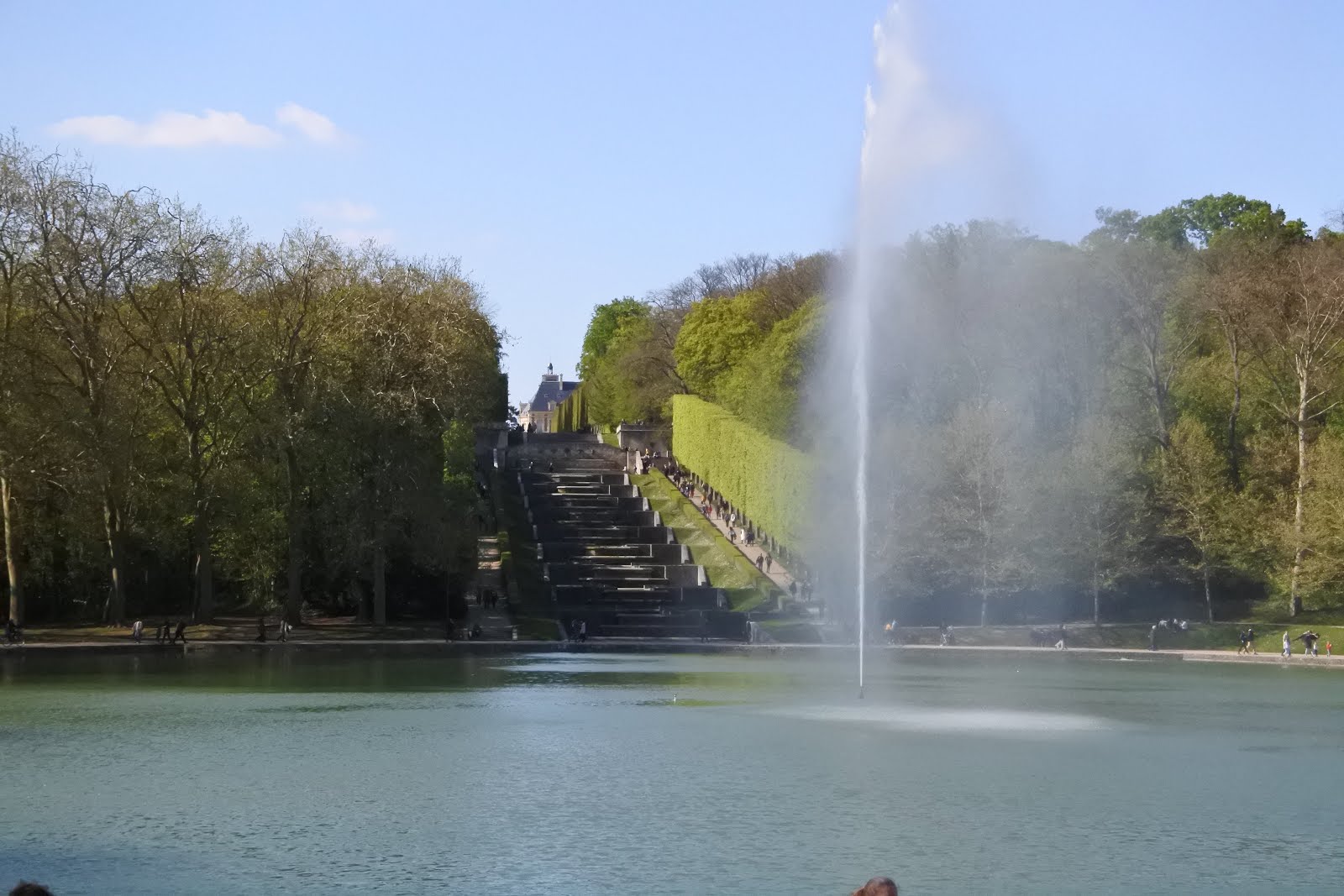
Last Sunday was May Day, which is a national holiday in France, although it was a Sunday so people were off work anyway. Talia and I decided to take a trip to the Parc de Sceaux. This is a large garden in the suburb of Sceaux (pronounced "so"), formerly the grounds of a stately home (and historically a castle). It's about 30 minutes by commuter train from the centre of Paris. The park was busy, but nowhere near as busy as anywhere in Paris!
There's a huge "canal" through the centre of the park.
And some really beautiful water features.
Us! I'm struggling to keep my eyes open in the sun. See the beautifully-tended gardens behind us!
The old country mansion at the centre of the park has a museum inside, but being a Sunday (and a public holiday), it was of course closed. No matter, as it was absolutely delightful being outside and strolling around in the sun with a gentle breeze blowing. I hope you're enjoying the weather wherever you're reading this from.

Sunday, April 24, 2016

A trip to London


Last week we went to London to see Soraya, a dear Baha'i friend from Columbus. She was just on her way out of the UK after studying in Oxford for a term. It's easy to forget how close London and Paris are - it's just 2 and a half hours by train from city centre to city centre. London is closer to Paris than it is to Glasgow, and Paris is closer to London than it is to Marseille!

So, it wasn't difficult to hop up to England to see Soraya. We had planned to visit the New Southgate cemetery, which is where Shoghi Effendi (the leader of the Baha'i Faith from 1921 to 1957) is buried. It's a little far from central London so I think Soraya appreciated us being able to help her with directions and navigating the tube.

A view of the resting place of Shoghi Effendi. The tulips were blooming!
After paying our respects at the cemetery, we toured around central London a little. This included a trip to Oxford Road, where we looked in shops for baby things, and Soraya practically fainted at the cost of pushchairs. ("How does anyone afford to have children?") We also got to explore the famous department store Selfridge's, which we were disappointed to discover does not actually sell fridges.

Talia outside of Selfridge's
At the risk of making an obvious statement,London is different from Paris.

Yes, I've become that person who visits somewhere and then spends the whole time comparing it to wherever they live. ("Ugh, these baguettes aren't as good as in Paris.") This can be obnoxious if the place you're visiting is a little village or in a radically different culture, but in the case of London, it feels appropriate to compare it to Paris. (Both are global cities consistently ranked in the top 5 for participation in the worldwide economy.)

So, some observations that I made, in no particular order:
  • London is cleaner. Not just the streets, which have less litter and, uh, organic detritus, but even just the trains and buses seem to be less grimey.
  • The London underground (locally known as the tube, although I kept calling it the métro), especially the older lines, has small tunnels, claustrophobic trains, and feels much more like a series of old mineshafts. By comparison, most of the Paris underground feels like a set of train stations that just happen to be underground.
  • The architecture in London is less varied than that of Paris. I'm not sure to what extent this is due to London neighbourhoods being levelled during the blitz in WWII...
  • London also feels much much bigger than Paris, and the transport system is much more confusing, although these feelings might just be due to Paris being familiar to me and London unfamiliar.
  • Also, people speak English in London, and French in Paris, but I overheard a surprising amount of French in London. Apparently somewhere between 70,000 and 300,000 French people live in London, giving rise to the claim that London is France's sixth largest city.
I'm curious to know if others share my perspectives (even if you've only visited one of these places). Let me know in the comments! Part of the fun of travelling is seeing how things are different or the same from places you are used to. I'm not sure what I am "used to" now (having lived in three different countries), but comparing things can still bring fresh insights.

Sunday, January 24, 2016

Cycling in Paris

A laid-back cyclist symbol on a side street.
Paris has an excellent metro system, which moves 4 million people a day. There's also an extensive bus and larger commuter train service. More recently, however, the city officials have been trying to encourage more cycling, partly to reduce traffic congestion (of which there is a lot), and to improve health and well-being. This means that recently there have been a number of bike-friendly changes to the road infrastructure. There are several bike lanes, of various degrees of separation from the traffic, and also bikes are able to share the bus-and-taxi lanes. Several one-way streets are actually two-way for bikes, which makes navigation easier, and at some traffic lights there are signs indicating that bikes can proceed (either forward or to the right) at a red light, if the coast is clear. On Sundays and public holidays, some roads near the centre of town are closed to all non-bike non-pedestrian traffic. And there was the journée sans voiture, when cars were banned from the city centre. Still, even with those bike-friendly policies, surely it's a terrifying notion to go out onto the road with wild Frenchmen? After all, tourists (Brits and Americans alike) return with crazy stories about the frenetic, chaotic traffic in Paris. And there is video proof!

Well, I've been cycling to work more or less since I began in September, and I can tell you: Paris is a joy to cycle in. Outside of Amsterdam, I can't think of a large city that I would rather cycle in. Let me explain why.

Other cyclists

First of all, strength in numbers. It's much easier to brave the streets when there's a whole gang of cyclists you're moving with than when you're on your own. On my way to work, I routinely cycle with at least one or two other cyclists who happen to be going the same way at about the same speed. Total strangers, but we stick together on the road and feel safer. On the way back it's not uncommon to see about half a dozen others, especially on the busier roads. This feature isn't unique to Paris, of course, but it makes cycling easier, especially for a relative novice like myself.

Other road users

The first thing to understand about the traffic in Paris (and many other large European cities like Rome) is the preponderance of motorized scooters and small motorbikes. They are everywhere, and they zip around everyone. They go in bike lanes, bus lanes, they jump red lights, they'll even go on the pavement (sidewalk, for the American readers) to get around an obstacle. This is not to say that it's totally anarchic - I'm definitely over-emphasizing their wildness - but simply that these motorbikes are an established part of the Parisian traffic.

From the perspective of a car driver, then, a bicycle is just a smaller, slower, more timid moped. The car drivers are used to looking out for mopeds, checking their blind spots, being conscious of allowing them to filter through traffic. As a consequence, they're very conscientious of bikes. There have been several times, when I move past a line of stopped cars to get to the front at a red light, that a car has actually moved slightly to give me more space to get past. I've almost never seen that happen in the US or the UK.

Another thing to understand about Paris traffic is something that sounds quite obvious - the laws are different here. The rules of the road, and of who has right of way, are quite different to those of the US and UK (and quite unintuitive if you were raised in either of those systems). While Brits may think the French traffic to be chaotic, the French think British traffic is inflexible. There have been maybe three times when I have misunderstood the rules of the road and turned when I didn't have right of way, and so on. Each time, rather than tooting their horn and yelling at me, car drivers have slowed and allowed me to pass, even though they had every right to continue. It seems that bike-riders are extended some courtesy - even excessive courtesy - which is perhaps not extended to other car drivers.

The Velib' system

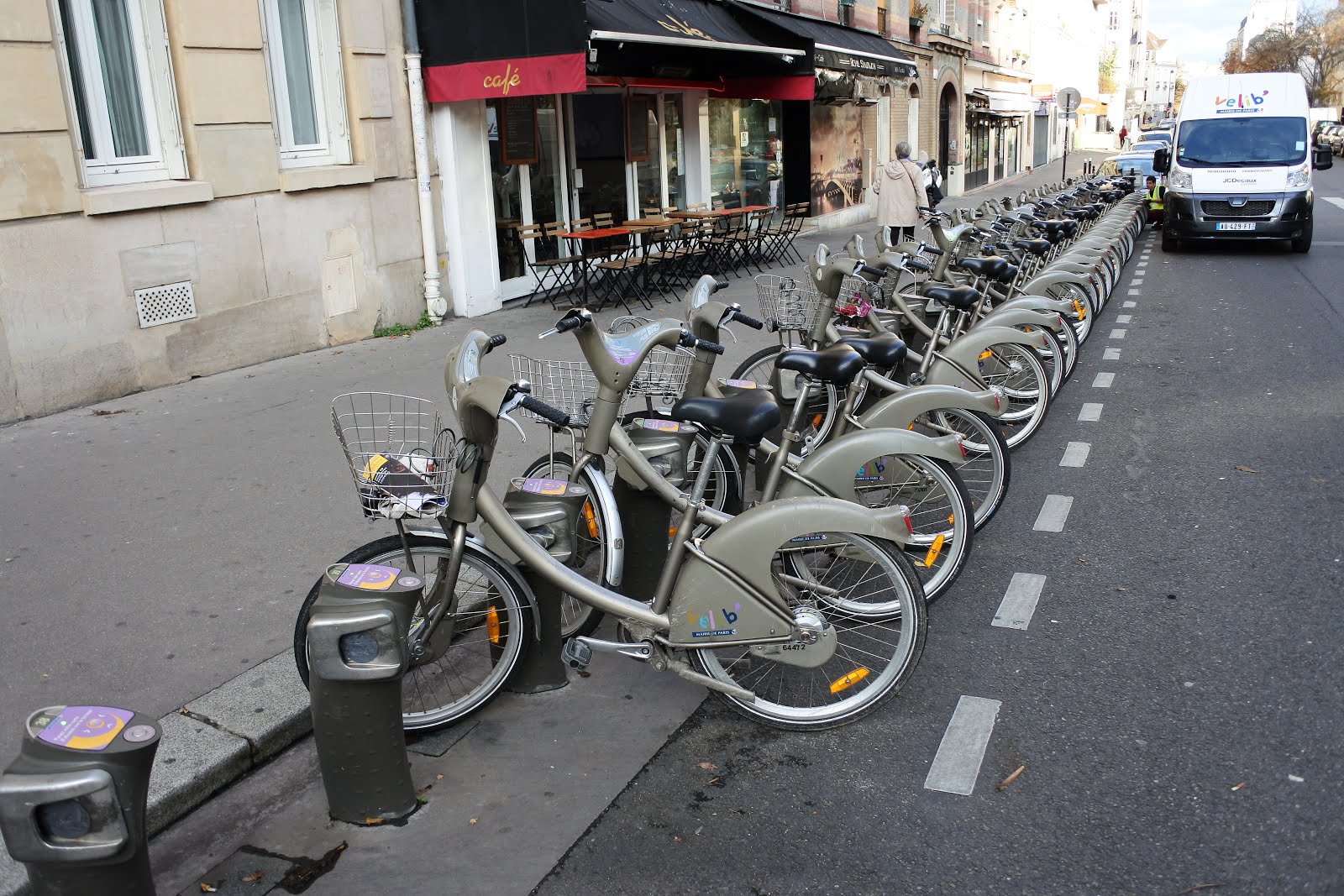
Paris has a bike-share system called Velib' (a blend of vélo "bike" and liberté "freedom"). There are similar systems in many other cities you may be familiar with (like Toronto, Columbus, London, and others). In case you're not familiar, here's a brief explanation of how it works:
A bike station with some attached bikes.

There are bike stations all over the city, each with several bikes attached. You scan your card on the bike stand of the bike you want, and the bike is released and you can take it. When you're finished, just park it back at any other bike station, and you're good.

The bike is free for the first thirty minutes, and after that you pay a small amount per half hour. There is also a subscription cost - 1.70€ for a day, 8€ for a week, or 29€ for a year. Yes, a year's subscription at only 29€, which gives you free half-hour bike rentals. Much cheaper than buying and maintaining your own bike.
The cupboard was bare!

It's possible that when you go to return the bike, the station is full. Or that when you want a bike, the station is empty. Luckily, there are stations everywhere. There are over 1,000 stations, and over 30,000 bikes, in the entire system. It's the largest bike-share system outside of China.

The bikes are of varying quality. Sometimes the brakes are iffy, or there's a punctured tyre or broken chain. Thankfully, an informal system has sprung up where if someone notices if a bike is bad, they turn the seat to face backwards. That way it's easy to see at a glance if a bike is suitable. I've had a few duds but mostly the bikes are good, and the stations are so common it's easy to drop off a bad bike and exchange it for another.

My route to work

Finally the last reason that cycling in Paris is so enjoyable is the reason that many things in Paris are enjoyable - it's Paris! Every day on my way to work I get to see the Notre Dame, (a glimpse of) the Eiffel Tower, the Place de la Bastille, the Pitié-Salpêtrière Hospital, the Jardin des Plantes, the Grand Mosque of Paris, and many other sights. It's very exciting!

Cycling is Paris is not as scary as it may seem at first, and there's lots of ways that it's been made more pleasurable than it could be. I definitely enjoy having the freedom to cycle around, rather than having to be squeezed into a metro train or a bus. If you come to Paris, let me take you out cycling :-)