Showing posts with label france. Show all posts

Saturday, April 14, 2018

Time flies when you have no seasons


The island of Moloka'i, where we visited in March
It's been six months since I last wrote a blog post. We have now lived in Honolulu for eight months, but I have to say, it doesn't feel all that long. The funny thing about Hawaii is that the seasons give you little indication of the passage of time. It was not uncommon for me to think this year, “What a lovely summer day!” and then realize it was February. It's disconcerting. Only the greener color of Diamond Head Crater hints at the presence of winter. Trees seem to flower year round and mid-winter beach trips are the norm, so it's easy to forget what time of year it is. Although the months have slipped by without me hardly noticing, when I reflect on how much my daughter has developed over the last eight months, I realize just how much time has actually passed.

We moved to Honolulu right before Maëlys turned one. She hadn't started walking yet—she was still doing her funny one-legged crawl. She didn't understand most of the words we said to her. I was feeling guilty for not throwing her a first birthday party, but we had no furniture in our apartment and few friends to celebrate with. She didn't mind—she enjoyed opening presents from her relatives, and then lost interest and moved on to something else. She was changing rapidly, but still firmly in the baby category.

Maëlys at 20 months
Now Maëlys is four months shy of being a two-year-old. We're on the verge of starting toilet training with her, she's playing imaginatively with her stuffed animals, she goes to a toddler gym class and can climb, jump, and slide with ease. She can only say a few recognizable words, but she understands and responds appropriately to complex sentences. She teases people, laughs at jokes, and demands back rubs for herself and her toys. Our baby is a baby no more.

In our eight months here, France has also quickly faded into the background. Now, a dream-like fuzziness blurs the edges of my memories of Paris. My French accent sounds atrocious. I have not kept up my French skills as I had wanted to, unfortunately, and it's surprising how quickly my vocabulary has dwindled, only to be replaced by long Hawaiian words that I frequently mix up: Kapahulu, Kaka'ako, Kalawao, Kapiolani. I still keep in touch with a few friends from France, and we send occasional Maëlys photos to our sweet former landlady. But for the most part, our lives have become firmly entrenched in Hawaii and France is now just an anecdote that makes me sound cooler than I really am.

Still, every time I watch a movie set in Paris, my heart skips at the familiarity of the simple things: the blue and green street signs on the corners of buildings, the bright neon vests of the sanitation workers, the sound of the doors-closing alert on the métro. It feels as if I'm still there and need only open a window for the smell of cigarette smoke to waft upwards, for the blaring of car horns and sirens to punctuate the usual low rumble of noise. I miss it. Something which was so frightening and unfamiliar to me for so many months now feels like home. Never mind that in Hawaii I can go to the beach any time I want. Never mind that I can see tons of constellations from my balcony, not just an occasional star or satellite. Never mind that I can breathe clean air and feel safe in my neighborhood. I miss the character of Paris. I miss the feeling of power that comes from crossing a busy street with a throng of other pedestrians. I miss addressing people as monsieur or madame and knowing that I'll hear “Merci, au revoir” when I leave a store.

I'm certain that when I look back on my life, our time in Paris will be two of the best years I ever had. Perhaps two of the hardest as well, but certainly two of the best. That's not to diminish the wonderful new lives we're building for ourselves in Hawaii, of course. I'm constantly in awe of our surroundings--Rory and I get to live in a gorgeous place that most people only dream of visiting, and we both get the chance to work and do what we love while raising an incredible daughter together. Hawaii is full of aloha.

But there's something special about Paris. A certain je ne sais quoi...

Wednesday, October 11, 2017

Shifting Perspectives: Transportation in France and America

America is a car-centered society. We bought a car within a week of moving to Honolulu because we realized how necessary it would be to get around. In our two years of living in Paris, on the other hand, we took less than a dozen car rides, usually in taxis. Very few of the people we knew there owned a car, most preferring simply to walk and take public transit. Parisian public transportation may be grimy and congested at times, but tickets are cheap, service is punctual, and stations are everywhere. With the high cost of fuel and the absurdly expensive and difficult process of acquiring a French driver's license, for many people, public transit makes much more sense than car ownership.

Furthermore, Paris engenders a culture of walking. Everyone walks to the shops, to their dentist appointments, to pick up their children from school. Most neighborhoods have several grocery stores within a ten minute walk—I can think of at least eight near our old apartment. I mentioned in a previous post the three separate free medical clinics for mothers and children in walking distance of our home. I even knew women in Paris who walked home from the hospital after giving birth. With almost every amenity one needs so conveniently located, walking is often the logical choice. It became such a regular part of my daily routine that I thought nothing of spending a few hours on my feet each day, both for getting from place to place but also for enjoyment, exercise, and relaxation.
Maëlys certainly enjoys walking in Hawaii.
So I find it continually surprising how few people I see walking in Honolulu. Here, despite the year-round nice weather, it seems that most people only walk if they have to. For many people, stores, restaurants, medical facilities, and other necessities are too far away to walk to or are inaccessible by public transport. There are often no sidewalks on residential streets, confirming the dominance of vehicles over pedestrians. And while Honolulu has an excellent bus system that covers the whole island, I would bet that a majority of residents have never ridden the bus or have used it only a few times in a given year. Sadly, I must include myself in that category, as I have not yet tried out the bus system (though Rory and Maëlys have made one bus trip so far and it is on my list of things to do).

The funny thing is, it only took two years of living in France to completely change my perspective on the dominance of cars. Before moving to France, I viewed my car as more than just a way to get around town; it was my own private refuge. I enjoyed being in the car, listening to the radio. And if I had to walk for more than five minutes to get somewhere, I would usually just hop in the car instead. I don't think I was particularly lazy, nor was I unconcerned with the environmental impact of driving. But my perception of what was an acceptable walking distance was skewed. I had no sense of how far away places were except in terms of driving time, so walking typically felt like an unnecessary and inefficient use of my time.

After living in Paris, I now much prefer to walk rather than drive. The fact that a place is far enough away that I must drive to get there is now a deterrent for me going there. But alas, my options here are limited when it comes to stores, restaurants, medical facilities, and schools that are within walking distance of home, so I feel myself being pulled back into the habit of driving that I so easily gave up in Paris. Honolulu does have buses and a new bike sharing program, but service is relatively limited, and the convenience factor is far less than simply jumping in a car. So for now, to combat the influences of America's ever-present car culture, I'm trying to patronize the few stores that are located near our home (walking there, of course), take daily walks around our neighborhood, and avoid unnecessary trips in the car. And one of these days, I'll have to try out the bus.

Sunday, September 3, 2017

Iceland ahoy!

After I woke up this morning, September the third, my Google Calendar app reminded me of my flight to Reykjavik in a few hours. Boston to Reykjavik, it says, 1pm, don't be late!

To explain this state of affairs, I have to tell you the story of our leaving Paris. Let's start in, oh, March or so, when I'd accepted the job in Hawai'i and as we were making plans.

The goal: Get from Paris to Honolulu.

This presents a challenge, because this journey takes at least 24 hours. The journey with a baby would be particularly difficult. Plus, once we get to Hawai'i, the time difference is 12 hours - as big of a time difference as is possible. It'd be 8am, it'd feel like 8pm. At 4am, it'd feel like 4pm. Not an easy adjustment for adults, let alone babies.

However, it also presents opportunities. I checked a map, and apparently right between France and Hawai'i is a large continent known as North America. We have a lot of dear friends in Ohio (plus a storage unit with things from our old house that we didn't take with us to Paris), and family in Oregon.

So we decide to hop. Go to Ohio first (only a 6 hour time difference), spend 10 days there, see friends, pack up our storage unit and have it shipped to Hawai'i. Then onward to Oregon (a 3 hour time difference), spend two weeks with family. Finally make the last leg over to Hawai'i. Simple, right?

Yes and no. This plan has us getting to the US on June 30, and slowly travelling west until we get to Hawai'i on July 26. Here's the problem: my visa is only valid from July the 22nd. How can I get into the US on June the 30th?

Well, the first part of our trip is just tourism, I consider. I won't be working or earning any money - just seeing friends and family. So I could enter the US as a tourist, under the visa waiver program called ESTA. I enter on ESTA, and then change my status to my work visa. Simple, right?

Yes and no! You can't change status from an ESTA to a work visa. It's not allowed. You have to leave the US and then re-enter on the work visa. This sorry state of affairs then motivates a solo trip from Oregon up to Vancouver, Canada, to allow me to hop out and back into the USA. I book some train tickets and add it to our itinerary. A complex plan, but everything should work out.

We began our preparations in earnest. We sold most of our Paris possessions. We mailed a few boxes of books and things to await our arrival in Hawai'i. And the rest we packed. We ended up with four large suitcases, one smaller roller bag, one laptop bag, two backpacks, and a cello. And of course, a small baby.

We had emptied and cleaned our flat, our landlady had deemed it vraiment impeccable, très propre ("truly impeccable, very clean"), and with tears in our eyes we left for our airport hotel, where we were to spend the night before flying out the next morning. It was at this point we learned of a small flaw in our plan: we didn't have enough hands.

That is, there were more suitcases than we could easily move. With a luggage cart, it's possible, but with just the two of us, it's not straightforward. Even though our hotel is basically right beside the airport, we realize that we need to book a taxi to ensure that we can get to it effectively. I speak to the agent at the front desk and get a taxi booked, after I make sure he understands that we have a lot of luggage.

(It is here, at the hotel, I discover the value of speaking English and pretending not to speak French. The staff are more revealing when they turn to their colleagues and address them in French. But I'm listening...)

In the morning, we awake and await our taxi. It arrives, but it's plainly too small. They clearly didn't get the memo about our luggage. The driver calls in for another taxi to come, and we are resigned to waiting some more.

I'm a fairly anxious traveller, I'm not sure why, but these events send me spiralling into worry. We've barely begun our trip and there's a delay! What if they don't have a taxi big enough? What if the taxi arrives late and we miss our flight? How will we manage?

Luckily the taxi soon arrives. It's driven by a middle aged Japanese immigrant, who regaled our ears with easy-listening guitar covers of classic rock songs at high volume. He was really keen on it.

At the airport, we went to check our luggage. We had booked and paid for the extra luggage in advance, but I was expecting to have to pay 200€ for Talia's cello, which is technically oversize.

After weighing everything, they tell us that some of our bags are overweight and that we have to speak to another person to pay the fee and get the tags. I head over to the other person while Talia waits with Maëlys.

"Okay sir, for all of this, you must pay 750€."

My eyes boggle.

"No, there must be some mistake. See, here, I have already paid for these bags. I am only paying for an overweight fee for one of the bags." I brandish my receipt from when I booked the bags. (If there's one thing I've learned from living in France, it's that paper documentation is king.)

"Let me see. Actually, we can distribute the weight of the bags across all of them, so while this one bag is overweight, the total weight of everything is under the limit. So there's no fee. Let me print your passes now."

However, this was followed by brow-furrowing and talking to colleagues. The wait was long, and I was getting worried again. We'd arrived at the airport a little later than I'd wanted (because of the taxi) and now we're being delayed again. What if security takes forever too, and we miss the flight?

Eventually the airline people come to a consensus and tell me that although I'd paid for the luggage on the second leg of our flight (Frankfurt to Pittsburgh), the first leg (Paris to Frankfurt) was not covered. This is apparently because these legs are operated by Condor and Lufthansa respectively.

Never mind the fact that they're both part of the same parent company. Never mind the fact that when I paid for the luggage, I spoke to operators at both Condor and Lufthansa who told me that the payment covered both flights. Never mind that. Right now, they wanted 150€.

At this point, I pay. I reckon I could have stayed and argued my case, but to be frank I was happy to just get the luggage onto the plane and be able to get going. My anxiety was getting the better of me.

And, remember I expected a 200€ charge for the cello? They never mentioned it! So really, this was like gaining 50€. That's what I told myself, at least.

Security was fine, the Lufthansa flight was great. The flight attendant gave Maëlys a little toy to entertain her on the flight, which we got to keep. Everything was looking up!

Now for the Condor flight. Condor is a low-cost airline, and we got some great rates with them. So great that booking three seats (i.e. a seat for Maëlys, which is a game-changer, let me tell you) was actually cheaper than just two on some other airlines. However, there are restrictions, and their policy on hand luggage is relatively strict. I had read flyer reports where they actually weighed people's hand luggage to ensure it's below their maximum weight. This worried me, as we had a lot of stuff.

When we go to board, the boarding agent sees that our passes haven't been double-checked, and send us over to another agent. Here we go, I think, they're going to weigh our bags. No such thing happens. Instead, they check our passports.

"Two Americans and one British person. I see. Do you have travel authorization to go to the USA?" she asks.

"Yes, I have an ESTA", I say, referring to the visa-waiver program.

"And do you have onward travel outside of the USA?"

She asks this because if an airline brings someone to a country, and they are denied entry, the airline is liable for the cost of taking them back to where they came from. Airlines are really tough these days on anything that looks like you might be in violation of the rules. The ESTA, as a short-term thing, requires that you have evidence of onward travel to leave the country.

"Yes, to Canada." I show her the document. "And see here, I also have a work visa, so I'll re-enter the US as a worker."

"Hm. No, Canada is not good enough. You have to leave the entire continent."

For various reasons, going to Canada or Mexico (or various Caribbean countries) doesn't count for leaving the country. This means that, say, someone in the US on a student visa can go to Toronto for the weekend and not have to go through complex immigration procedures upon their return. Paperwork is minimized, student gets to go to Toronto, everyone is happy.

Except that this rule also doesn't make sense, because you have left the country. You can't legislate that away.

I argue my case, that I have a work visa and that I'll be re-entering the US. She stands her ground.

"I need to see onward travel out of the US. Here is a list of countries which don't count." It's a long list, with lots of Caribbean nations, plus Mexico and Canada.

"What do you want me to do? Just get out my laptop and buy a plane ticket right now?"

"Yes."

Great. So I do that. Due to a lack of foresight, my laptop was not charged, so I needed to find an outlet. The first one I found was not in a location with a wifi signal. The second one worked. Meanwhile, our flight is boarding and I am freaking out.

I do a quick search for flights from US east coast cities - Boston, Newark, JFK - to major European hubs - Paris, Frankfurt, London. I select a date in the near future which is within the 90 days I can be in the US on ESTA. I find a cheap flight with Wow Air for about 160€. It goes to Paris via Reykjavik. Since I'm in Germany, my computer has defaulted to the German webpage. I click through and order my ticket, hoping that my understanding of German was good enough. I get a confirmation page.

I run back to the agent and show her the flight. She glances at it, nods, and waves us through onto the plane.

And that is the story of why I was meant to fly to Reykjavik today.

Of course, the US immigration official didn't care about whether I had onward travel. He didn't even ask how long I was staying. When you are white and travel with two white Americans, one of whom is a baby, they don't check you very thoroughly.

I later cancelled the flight, as I had no intention of taking it, and was reimbursed the 35€ or so that they charged in taxes and fees.

In hindsight, I could have handled it better. I could have just bought tickets to Reykjavik without onward travel to Paris, that would have been cheaper. I also learned that US law entitles you to a full refund within 24 hours of buying a flight. (A rare case where US law is more consumer-friendly than EU law!) Since I bought my ticket through the German site, I wasn't eligible for this, but I would have been had I used the US site.

All this to jump through the hoops of getting to the US and dealing with our complicated itinerary and complex immigration laws. Our other travels within the US (and to Canada) were not without incident, but not quite as eventful or as stress-inducing as this first one. Maybe one day I'll make it to Iceland for real.

Sunday, May 21, 2017

Carcassonne

In our last post, Talia described our recent trip to Barcelona. It ends with us boarding a train bound for Carcassonne, a town in the southeast of France. (It's roughly halfway between Toulouse and Montpellier, if you know where they are. If not, just imagine a line due south from Paris but stop about 65km from the Spansh border. Or just look it up on a map.) What adventures would await us there?

Something Talia didn't mention about Barcelona is how cheap everything was! It's a major city, but the prices in supermarkets and restaurants compared very favourably to Paris. I suppose the real lesson from this is that it is expensive in Paris, and we've just got used to it...

Anyway, the train ride to Carcassonne was lovely. It was just as the sun was setting, and we had great views of the Pyrenées and the Mediterranean. It was around Maëlys's bedtime, so she was a little grumpy, but we were all still able to enjoy most of the trip.
Water, hills, as viewed from the train from Barcelona.
The only thing that marked our entering France was that the automated announcements switched from Spanish, French, and English to just French. This was strangely comforting, in a way. While Talia is pretty competent in Spanish, I am very weak, and being in Barcelona - while enjoyable - it was very clear that I was in a foreign country.

By contrast, coming to Carcassonne, a place we've never been before, was very much like "coming home". The train station was basically like every other provincial French train station. We made our way to our accommodation (an AirBnB), and spoke only French with the host. We knew all the quirks of the French apartment and the French appliances. That it was all so familiar was surprising, as to a large degree France is still a foreign country to us. But it helped us to realize how much of a home it's become.

The next morning was Sunday, and I ventured out to one of the supermarkets to pick up supplies. (Being "at home" means realizing that not many supermarkets will be open on Sunday, and knowing that those which are are probably only open for the morning.) The town was dead quiet. It was a real contrast from Barcelona, full of people and wide thoroughfares with cars and mopeds. Here, I wandered down some cobbled streets, passing only a couple of people. The other people in the supermarket were tourists too.

One of the main entrances to the walled city.
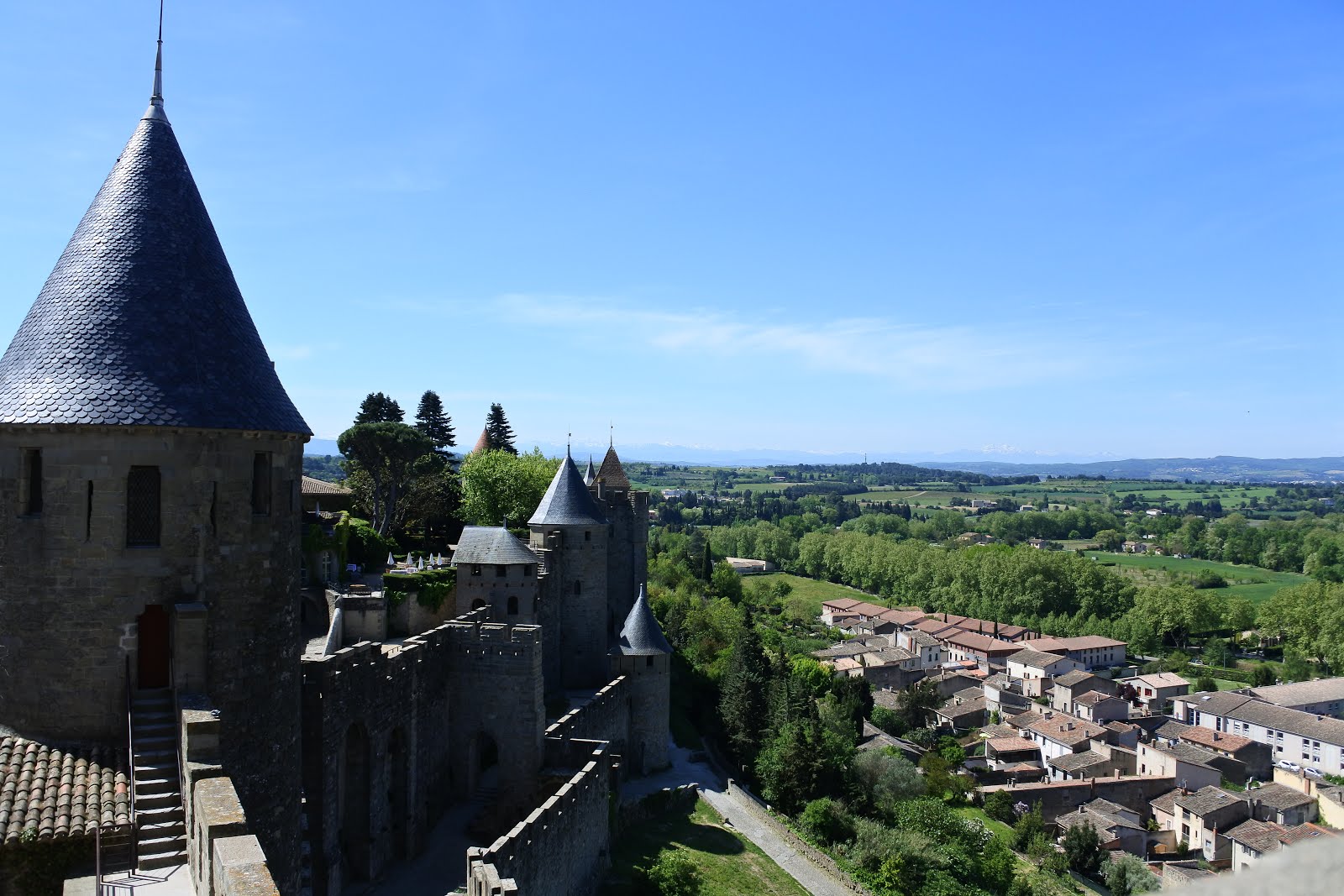
Carcassonne is most famous for its medieval city. This dates back to Roman times, with fortifications being added over the centuries, to defend against threats from outside (those barbaric Spaniards!) and inside (those dangerous commoners!). After falling into some disrepair, a lot of it was rebuilt in the 1800s in an attempt to restore it to its former glory. As it turns out, a lot of the "restorations" were actually just people imagining what they thought a medieval castle should look like, rather than historically accurate rebuilding, but that seems to be part of the appeal. I'll let the pictures speak for themselves.

Another entrance!
A view over the rooftops. Yes, those are houses - people actually live here.
A view from the ramparts down to the town and countryside below.
A view of the southern end of the city.
As you can probably tell from the pictures, we had cracking weather. It was about 25C (77F) and sunny, with clear skies. Great weather for a holiday!
A window in the Basilica of Saint Nazaire, inside the old city.
You may also be familiar with Carcassonne as the name of a board game. The game, inspired by the real city, involves building cities and roads between them in rural medieval France. We saw it for sale in one of the tourist shops, which I thought was quite appropriate.

The aptly-named "old bridge" over the river Aude.
Naturally, each region of France has its own culinary delicacies. Carcassonne is famous for cassoulet, which is a type of stew consisting of white beans, pork sausage, and duck meat, all cooked in lard for hours. Talia had some for lunch, and didn't need any more food for the day.
When in Rome...
After our trip to the old city, we meandered our way back to our accommodation, which was in the newer part of town. Because there isn't really too much to do in Carcassonne, there was none of the usual "tourist-pressure" I feel of having to go and see everything and maximize the amount of experiences enjoyed. Instead, it was extremely pleasant to have a leisurely time. The next day, we enjoyed a relaxed morning before taking a little boat trip along the canal. In the early evening, we took a local train to neighbouring Narbonne, before boarding the high-speed train bound for Paris. Again, the train ride was excellent. For the first portion, the track mostly hugs the Mediterranean coast, providing excellent views. Then, turning left, it's northward to Paris, through the French countryside. We got home at about 11pm; a sleeping baby and tired parents.

Carcassonne was a lovely break. Of course, it's definitely a tourist town, but that doesn't really detract from the beauty of it. (And we live in Paris anyway, so being around tourists is just part of life...) If we had the time, it would have been great to rent a car and just explore the region, stay for a week or so. The pace of holidaying in rural places is quite different from that of Barcelona, and I'm glad that we managed to fit both of them into this trip. I'm also glad that we did it in this order - the quiet timidity of Carcassonne and the comforting familiarity of France was an excellent sequel to Barcelona. The other way round wouldn't have paced itself quite as well. Roll on our next holiday adventure!

Monday, April 3, 2017

Château de malmaison

Two weeks ago, March 20th, was Naw-Ruz, the Baha'i New Year. I took the day off work and we decided to go on a short day trip to welcome in the new year. The weather was pleasant -- bright but cloudy, dry and reasonably warm. It was a welcome change from winter.
The château de malmaison.
We settled on visiting the Château de Malmaison, the former residence of Empress Josephine, Napoleon's first wife. This is in the suburb Rueil-Malmaison, a short train or bus ride west of Paris.

If you know some French, you probably realized that "Malmaison" sounds like "bad house": mal means bad or wrong (like in the English words maladjusted and malnutrition), and maison means house. Sometimes when you see curious expressions like this in place names, it's actually a coincidence, and the name originates with some other words, perhaps words which are now archaic or forgotten, or even from a different language. For example, the names of the English towns of Puddletown and Catbrain are actually derived from Middle English phrases meaning "farmstead on the marsh" and "soil mixed with clay and stones", respectively.

In the case of Malmaison, however, it really does have the meaning we think. In 846, a mansion in this area was burned to the ground by Viking invaders. The area was then dubbed malmaison, meaning "mansion of back luck". Looks like the name stuck!

On the way to the chateau, we bumped into the parc de l'amitié, the park of friendship, a local park with some Japanese gardens, a rose garden, and some other features. Given the name and the Japanese theme, I thought that perhaps it was a garden of international friendship -- perhaps the results of the town being twinned with somewhere in Japan, or something like that. But I was unable to find any evidence of that. As far as I can tell, the city planners just wanted to build a cool park. That's okay with me!

The Japanese garden featured a pond and a scenic bridge. And blossoms, lots of blossoms.
In the grounds of the chateau itself is an art collection of Daniel Iffla, a 19th-Century French financier and philanthropist who named himself Osiris (yes, the same name as the Egyptian god). It was a modest collection of various objets d'art from various cultures around the world -- China, Persia, Greece, Rome. It was also really dark inside (presumably to protect the art), and quiet. It doubled as a good place to quickly change and feed Maëlys, too.
Osiris himself!
It was lunchtime when we arrived, and the chateau closes for lunch! The gardens were still open, however, so that afforded us some time to enjoy our own lunch (we'd packed a little picnic) and look around. The gardens are home to a large rose garden, not in bloom at the time of our visit, and several statues and little streams dot the area. Attempts have been made to have the garden resemble how it was at the time of Empress Josephine, although in her day the gardens extended much further in all directions. Josephine grew up in Martinique, in the Caribbean, and so apparently having a well-tended, diverse garden was a particular source of joy for her. There used to be a greenhouse where she grew pineapples!

One of the garden paths, with the chateau in the distance.

As you can see in the picture at the beginning of this post, it is a nice building, but not particularly grand. That is, it is an excellent example of a stately home, but if you had asked me to guess who lived inside, I would not have imagined "empress". The reason for that is because Josephine purchased the mansion way back when Napoleon was just a general, busy invading Egypt. When Napoleon returned, apparently he was upset at her for purchasing such a run-down mansion that would require so much work to renovate! He didn't have much time to be angry, however, as he was busy planning a coup d'état to overthrow the unpopular government and install himself as emperor. They divorced in 1810 following acrimonious disputes about affairs and Josephine's infertility, although she remained Empress.

Anyway, the inside of the chateau was decked out as it was at the time of Josephine. There were lots of grand paintings, intricate timepieces, and fancy chairs. Absent was any kitchen or obvious servant's quarters, but apparently they were in other buildings in the grounds which have since been destroyed.

One of the receiving rooms inside the chateau.
There was a lot of Napoleon-themed pieces around, including the original version of the famous painting Napoleon Crosses the Alps, which depicts (in grand heroic style) Napoleon heading from France into Italy in 1800. Not pictured: his army!

Napoleon Crosses the Alps!
After we'd seen around the chateau, we hopped back on a bus and then a train and made our way home. It was a lovely trip outside of Paris for the day, and we're going to try to do more day trips like this as our move to Hawai'i gets closer and closer! As I looking back on the pictures from the chateau, it all looks a little drab and grey in comparison to the weather we've had here in the last week or so. It appears that we did a good job of welcoming in the spring!

Monday, October 31, 2016

Fontainebleau

Lest our blog become purely baby-related, I wanted to post some stuff about recent travels we have been on. Except... we haven't travelled since the baby arrived. Well, we've made trips around the Paris metropolitan area (which is a pretty big area), but we haven't really been out for more than a few hours or an afternoon or so. Life with babies is complicated!

But, earlier in July, we took a day trip to Fontainebleau, a town about 50km south of Paris. I had been planning to write about our trip, but I never got round to it! Let's do that now.

Fontainebleau is a popular tourist destination for Parisians, mainly due to the nearby Forêt de Fontainebleau (Fontainebleau forest), but also for the Château de Fontainebleau, regarded as one of France's most magnificent. The forest is pretty big, 280 square kilometres; that's approximately the same size as Edinburgh, Exmoor national park, or the borough of Queens in New York; it's just under 10% the size of Rhode Island. The forest is popular for hiking, cycling, horse riding, and rock climbing.

It took us maybe an hour to get there by train, and then a 10 minute bus ride from the train station to the town centre. Apparently it's a popular site with Chinese tourists, and there were signs in Chinese at the train station explaining how to use the buses. For us, since the trains and bus system are all in the "Paris region" transport system, we were able to use our monthly transport passes to travel. A day trip for free! Doesn't get much better than that.

The chateau de Fontainebleau.

The castle has been successively expanded over the centuries by its different owners, which has lead to a multitude of different architectural styles for the different wings. I'll let you judge whether this has a positive or negative effect on the overall appearance:
A view of part of the castle from a distance.
The château is surrounded by extensive gardens, including a lake. You can visit the inside of the castle (apparently the tour is well-regarded), but the weather was so nice we opted to remain outside and stroll the gardens.

Such tasteful decorations in the castle grounds. (Oui, c'est un chien qui faire un pipi.)
Some people relaxing with a picnic by the lakeside.
Another view of the castle from one of the tree-lined promenades.
We didn't venture out into the forest (there was too much to see at the castle, and Talia, being pregnant, only had so much walking energy for the day). Perhaps we will be able to revisit soon and have another exploration, this time with baby in tow!

Sunday, July 17, 2016

La fête nationale

Thursday, the 14th of July, was France's fête nationale, usually known in English as "Bastille day". This is France's big national holiday, with a big display of patriotism, similar to America's Fourth of July.
The "blue, white and red" of the French flag, courtesy of the airforce. (The middle stream looks grey, but that's just because this picture was taken looking into the sun.)
Most English-speaking sources that talk about Bastille day mention that it commemorates the storming of the Bastille (14th July, 1789). This event, as it is told, was when the common people of Paris spontaneously rose up, stormed a huge medieval fortress (the Bastille), and freed the political prisoners inside, in a display of their desire for liberty against a tyrannical monarchy.

Some guys on horses.
Imagine my surprise to learn that the fête nationale does not (solely) commemorate the fall of the Bastille, and that the fall of the Bastille had nothing to do with political prisoners! In the late 1780s, France was going through a crisis - plainly, the country was broke, and the systems of government were over-complex and not conducive to economic growth. Cutting a long story short, the common people were upset at having limited representation in the ongoing negotiations to solve the crisis, and for various reasons (some true and some untrue) they believed that the king was going to lead a militaristic crackdown on the people of Paris. So, they stormed a military storehouse to gather weapons, but there was no gunpowder or shot. The closest place that had gunpowder? The Bastille! This then led to an armed standoff between the military governor who was in charge of the Bastille, and the mob of angry Parisians outside of it, who were armed but with no ammunition. Eventually the mob won, and the French revolution sort of snowballed from there.

Shiny helmets and swords.

One year later, on 14 July 1790, the French government held la fête de la federation, to commemorate the events of the fall of the Bastille in a show of national unity and solidarity. This event came during a time of relative calm; a constitutional monarchy was in place, with the king presiding over a (somewhat) democratically elected representative government. Feudalism was abolished, outdated judicial structures reformed, and things looked good. This historical event is also what the modern-day fête nationale celebrates. (Of course, as we know, everything was not fine in 1790, and the revolution would proceed with the overthrow of the royal family, radical dechristianization of the country, the reign of terror, several wars in Europe and the Caribbean, and the establishment of a republic with many freedoms previously thought impossible.)

So, that's what the day celebrates, more or less. The end of the ancien régime and the founding of the modern French state, with its principles of liberté, egalité, fraternité (freedom, equality, brotherhood). Every year along the Champs-Elysées there is a big défilé militaire (military parade).
Crowds assembled along the Champs-Elysées to see the military parade.

We decided to brave the crowds to see the parade. There were many people on foot from many different divisions of the armed forces (including the gendarmes and firefighters!), some on horseback, and a lot of vehicles. Motorbikes, jeeps, tanks, amphibious vehicles, artillery guns, diggers, engineering stations, and even a few drone launchers. Then there were many planes and helicopters that flew overhead. Apparently the president also makes an appearance, although we must have missed him.
A tank rolls down the Champs-Elysées.
In the evening, there was a big concert at the Champs de Mars (in front of the Eiffel Tower), followed by fireworks. We'd had enough of standing in large crowds by this point, and so we decided to watch it streaming online instead. It was quite different from either an American Fourth of July "pops concert" or a British last night of the Proms, two equivalently patriotic music events. You can see the whole concert here, mostly music from French composers but not entirely, finishing, of course, with La Marseilleise, the French national anthem. The fireworks were launched from the Eiffel Tower, which gives a lot of artistic options that you don't have from a ground launch (such as firing sideways). Rather than being bombastic and awesome (the "shock and awe" approach of American fireworks) this firework display was more beautiful and aesthetically appealing. You can view it here.

It was only the following morning that we heard of the terrible attack that had taken place in Nice. Committing mass murder on a day that is dedicated to celebrating freedom, equality, and brotherhood is one of the more repugnant acts I can imagine, but what better way to respond than to reaffirm those values, to stand firm in courage against those who would seek to divide us? The Paris revolutionaries of 1789 would stand for no less.

Monday, February 29, 2016

On the road to Rouen

(Title of this post shamelessly stolen from the Supergrass album of the same name. And yeah, we took the train, so it's not even that accurate.)

Last weekend, we took a short trip to Rouen - we left Paris on Friday afternoon and came back on Sunday afternoon. Rouen is a small city northwest of Paris, about 75 minutes by train. It's the capital of Normandy and is principally famous as having several medieval cathedrals and also as being the place where Joan of Arc was tried and executed. For us, it was a chance to get out of the hustle and bustle of Paris and have a relaxing weekend. For Talia in particular, it was her first time exploring France outside of the Île-de-France region.

The journey begins.
I didn't know that much about Joan of Arc before going to Rouen, so here's a rough approximation of my knowledge. The background to the story is the Hundred Year's War between France and England, which despite the name, did not last for a hundred years (it was 116 years), and was not a war (it was a series of disconnected skirmishes and battles). During this period, the English crown was trying to assert authority over (parts of) France, while (parts of) the French royal family were fighting to oppose it. Joan of Arc was a peasant girl who had a number of religious visions showing a united France, and rose to prominence in leading successful attacks in several decisive battles. (To do this, she wore men's clothes, which was regarded with a mixture of shock and bemusement.) After a while, she was captured by the English (well, allies of the English in any case), and eventually put to death (by burning) for heresy. Given that Joan quickly became an icon of French culture, a symbol of fighting for freedom against an oppressive force*, the town that was responsible for putting her to death has been, at time, a little embarrassed of its status.

[* This is part of the myth-making that I don't really understand. It wasn't as if France was under the cruel yoke of a dictator and they were fighting for freedom and democracy. This was a war to determine which unelected hereditary leader was "rightfully" the leader of France. Not particularly noble in either case.]

Nevertheless, there are a number of Joan-related activities that you can do. Principally, you can visit the 13th-century fort where she was imprisoned.
The fort where Joan of Arc was held prior to her execution.

Rouen recently made most (all?) of their public museums free of charge. Consequently, we had the following exchange at the entrance to the fort:

Man: Entry is free. Well, except for the English. You're not English are you?
Talia: No, I'm American, and he is Scottish.
Man: Ah! American! Well, you liberated us, so you can go in. And Scottish? My grandmother was Scottish, so you're good too.

(Of course, he was ignoring the fact that the Scots fought on the side of the French in the Hundred Years War, including the fact that several Scottish soldiers fought alongside Joan of Arc during the siege of Orléans.)

Once inside, there was a good selection of historical information and Jean-related paraphernalia. One exhibit featured an amusing Franglish translation:

Her "eldbows"; she is "hearing the voices"; "made in biscuit".
The statuette in question. Looks delicious!
This post would be remiss if I neglected to include pictures of the grand churches and cathedrals. It felt like you couldn't go a few paces without bumping into another huge church or medieval tower.


The trip achieved its goal of being a relaxing (yet cultured) weekend away. There are many more regions of France to explore, so hopefully this will be the first of many such excursions!

Monday, January 18, 2016

Saint-Germain-en-Laye

Paris is very big, and there's lots to explore. According to Julián Carax, a character in Carlos Ruiz Zafón's novel The Shadow of the Wind, "one can't see Paris in two days, or in two months, or even in two years". There's too much!

Even so, it can be nice to get out of the city once in a while and explore the rest of France. After considering several options, last weekend we decided to take a day trip to Saint-Germain-en-Laye. This is a small town in the Île-de-France region and accessible by commuter train from Paris. Saint-Germain-en-Laye's main claims to fame are its fabulous chateau and grounds, and the fact that many royals made it their residence. Louis XIV, France's favourite king, was born there, and the chateau was also home to James the VII of Scotland and II of England (the same king) after he was exiled from Britain for being too Catholic.
"Louis XIV was born here". Apparently this is a big deal.
Most of the town is seated on a hill, so you can get a good view of the Paris region, including the skyscrapers that constitute the business district (la défense) and the Eiffel tower.
The Eiffel tower is that little blip in the distance beside the hill on the right.
The gates to the chateau.
Inside the chateau, naturally, is a large archaeology museum, with displays from the palaeolithic to the Roman era. It particularly focused on French archaeology, with displays of neanderthal burials, cave paintings from the south of France, and Gaulish settlements.
A neolithic carving - this one was barely bigger than a fingertip.
A bronze-age Zodiac calendar.
The museum was fascinating, really a lot of information in there. About a third of the exhibits were translated into English, and the rest we slowly puzzled over. When we were ready to leave, we just hopped on the commuter train and were home in 45 minutes! It was very pleasant to find this town. It was far enough from Paris that it didn't feel like Paris (being on the hill and being able to see far helped with that, I think), but also close enough that a spontaneous day trip was not full of travelling. Perhaps we'll take more day trips in the future.

Sunday, November 1, 2015

La Toussaint

Yesterday (November 1) was La Toussaint, the French name for All Saints' Day (also known as All Hallows). Despite France being a secular country, this Catholic holy day is also a national public holiday. (Yeah, French secularism is weird, and feels less consistent than American secularism, but that's probably just a matter of perspective. It's quite rare to see French politicians talk of their personal relationship with God, for instance.)

Most people from Anglophone cultures will know All Saints' Day as "the day after Halloween". After all, Hallowe'en is a contraction of All Hallow's Eve(ning), in other words, "the evening before All Saints' Day". However, Halloween celebrations as we know them in Anglophone cultures were quite missing on Saturday night!

Although the tradition of "trick or treating" is often regarded as being American in origin, it actually finds its roots in Scotland. Still practised today, children will go "guising", that is, going around the neighbourhood in disguise. They knock on the door of a neighbour, are invited inside, and have to perform a "piece" to get their reward (fruit, nuts, and sweets). The piece can be a joke, a riddle, a poem, a song, or some other performance. Apparently this practice in turn can be traced to traditions around the celtic pagan festival Samhain, the traditional harvest festival.

Okay, back to France. So, we didn't get to dress up, or give (or receive) any sweets, but instead, we got a public holiday with excellent weather! Yesterday was also the first Sunday of the month, which, as you may recall, means that many museums are open for free. We took advantage of this and visited the Musée du Moyen Âge (Museum of the Middle Ages).

Wow, the middle ages were pretty grim. Here's a statue of a martyred saint.
Yep, still pretty grim.
There was also some Roman artefacts, like this statue of Emperor Julian the Apostate.
Luckily, the middle ages weren't all doom and gloom. They had unicorns too.
And bunnies!
And books with pictures. Or maybe this is a colouring book?
After the museum, we visited Grom, an Italian ice cream shop. They have a variety of sorbets (milk-free, of course), and all of their cones are gluten-free. This is a winning combination for a happy Talia.
Apple and lemon sorbet!
We also visited the Panthéon, a huge mausoleum which houses the bodies of many of France's most famous men. (Yes, men. There is the body of exactly one woman in there: Marie Curie. However, two more women - Geneviève de Gaulle-Anthonioz and Germaine Tillion, both heroes of the French resistance during WWII - were added recently. Their bodies were not physically moved into the Panthéon (at the request of their families), but their names are listed among the others.)
Voltaire's tomb.
We also spent some time cycling around in the sun - the weather was really fantastic! (Unlike today, which is grey, cloudy, and barely more than 10C (50F).) Unfortunately, the camera battery ran out, so no pictures. But it was very pleasant.

So, while we may have missed out on the candy explosion of Hallowe'en in the USA, or more traditional Hallowe'en activities in the UK like apple dooking, a day of free museums, ice cream, and relaxing in the gentle sun definitely makes up for it. More of this, please!