Showing posts with label music. Show all posts

Friday, September 8, 2023

359 Days in the English Workforce

They say when one door closes, another opens. I just didn’t expect this door to slam in my face quite so soon. My journey into the British workforce lasted only 359 days. I didn’t even make it a full year. My final contracted day was last week, and as I left the Sage after returning my laptop and key card, I paused for a minute to look at the building that only a year ago, I was so excited to be calling my workplace. 

The Sage Gateshead
It’s a very unusual building, iconic. I think it looks like a shining, silver patchwork chrysalis for a gigantic caterpillar that’s resting along the quayside. The inside is just as marvelous. There’s no hint of a transforming butterfly–just massive, beautiful concert halls and exceptional views of the River Tyne, including the plethora of imposing yet graceful bridges that straddle the water, the nearly 900-year-old keep of Newcastle Castle, and all the amazing old buildings, spires, and clock towers that still make me marvel that I live in England. I felt a childlike excitement every time I beeped my way through the stage doors and into the front of house, always secretly expecting someone to stop me and ask what I was doing there. 

Newcastle quayside
Before we even moved to England, when Rory was just applying for the job at Newcastle University, I found the Sage after some quick googling and instantly knew that I wanted to work there. It’s not just a concert hall, but also provides a very robust community music education program. And the program I was most keen on being a part of was In Harmony. Similar to El Sistema music programs around the world, In Harmony is about transforming kids’ lives through music education. In Newcastle, it operates at two schools in the culturally diverse but lower-income West end. Every child at the school receives his or her own orchestral musical instrument as well as two to three hours a week of music instruction. All for free. It was the perfect fit for me, working with In Harmony, or so I thought.

The thing was, I knew, after fifteen years of teaching music, that I was done being a teacher. I had suspected that I needed a career change about eight years ago, but I persisted in music teaching because that’s what I had trained to do. Since I was a teenager I had wanted to teach music, and everything I did after high school prepared me to follow that path. So even though I knew, deep down, that I should find a job that aligned with my true self, where I wouldn’t have to put on an extroverted façade all day long, it felt too scary of a prospect to up and leave. That’s where In Harmony came in. 

An In Harmony program assistant job opened up last summer, and given that the program runs at my daughter’s school, and I would be working close to our neighborhood, it seemed like the perfect opportunity for me. It was a purely administrative job, not a teaching one, and it was in the music education field, so I would still feel right at home. Or, mostly anyway, because music ed in England is not the same as in America. But we’ll come to that later. I worked out of the two schools, doing mostly simple tasks like printing music and setting up chairs and music stands, and I could be as introverted as I wanted to be. There was very little stress involved, no work in the evenings, no sleepless nights agonizing over how to deal with difficult students. After two years of pandemic- and baby-induced stay-at-home momming, I was grateful to be out of the house and having conversations with adults again, even if the majority of my skills and training were not being put to use and most of my music teacher colleagues had no idea that I was actually one of them. It was a job and I was getting paid for easy work.

But this was my first foray into UK working life, and it was the first time since moving to Newcastle that I was surrounded by non-family British adults all day long. It was eye-opening. Although everyone was welcoming, more or less, I never quite got over my feeling of otherness. It was little things: having my colleagues offer me a cup of tea multiple times a day (nice, but strange), hearing different music terminology and pronunciations (see below), and not understanding 90% of the interactions I had with the school caretaker (US: janitor) due to his Geordie dialect. 

On one memorable occasion, I was talking with my boss and some of my colleagues, and I learned what I thought was a new British term. New to me, anyway. They were describing someone and feigning surprise at the person’s actions. “Shakara!” my boss said. Shakara? What the heck does that mean? I thought. Perhaps it was a word with roots in one of Britain’s former colonies, like pukka, or pundit. I pondered it the rest of the day, and when Google didn’t help elucidate things for me, I asked Rory if he was familiar with the word. He was puzzled too. But later that evening we had a breakthrough. Turns out I hadn’t learned a quaint new English word. I simply couldn’t understand my boss’s accent. It wasn’t shakara, it was shock horror. Oops.

British music terminology also required a lot of learning. It was strange to be working in the same field as I’d always been, and yet to not know the right words for things. Take rhythms for example. In the US, rhythms are described using a logical fraction system. A long, four-beat note is a whole note. A shorter two-beat note is a half note. One beat is a quarter note, and so on. In Britain, logic is nowhere in sight. Rhythm terms are random, and admittedly, rather comical. 
  • Whole note = semibreve 
  • Half note = minim
  • Quarter note = crotchet (how do people say that with a straight face?)
  • Eighth note = quaver (also the name of a cheesy crisp)
  • Sixteenth note = semiquaver
  • 32nd note = demisemiquaver
  • 64th note = hemidemisemiquaver (you’ve got to be kidding me) 

Perhaps it seems a small thing, to have to use new terminology and to not always understand what people are saying. But it’s those little things that cement the feeling of not belonging and shatter the illusion you create for yourself that you’re at home, doing what you’ve always done. They make you realize again for the thousandth time that you’re a foreigner. You’ll never quite fit in here. That’s life in the immigrant lane, I guess.

You may be asking yourself by now, what happened to the job? Why did it end? Surely Talia couldn’t have been so incompetent at setting up chairs that she was fired? (Yes, thank you for the vote of confidence.) Well, as with most things in the arts sector, it came down to money, or a lack thereof. The Arts Council England, a government agency that provided two-thirds of In Harmony’s funding, suddenly pulled the plug this year. I guess they decided that ten years of changing kids’ lives with music was quite enough. They left us with one more year of funding as a transition year, but starting in August 2024, the Newcastle In Harmony program will be decimated. As the last one in, I was the first one to be let go. It’ll only go downhill from here.

I’ve seen first-hand the difference that In Harmony makes in the lives of the children and families who participate. It transforms communities, it brings people from wildly disparate backgrounds together in one common endeavor. It gives children with minimal hopes for the future the tools and attitudes they need to overcome the innumerable obstacles in their path.

And it’s going down the drain.

In Harmony Newcastle will still exist after 2024. At least, in some form. Maybe not in both schools, maybe not for all the children, but a shell of In Harmony will remain. Yet it will never have the same impact as it does now, which, frankly, pisses me off. All the more so because my two kids should have benefited from this program throughout their primary school years, and now that’s been snatched away from them. Through In Harmony, my daughter started learning the cello in school, twice a week, from age five. My three-year-old son is going to have musicianship classes in his nursery (US: preschool) this year, taught by an excellent, qualified music teacher. That’s freaking remarkable. How many schools do you know that provide that level of music education? I’m willing to bet the answer is none.

And given the government’s disregard for the value of arts education, I expect there soon won’t be any schools left in England embracing music on the same level as they currently do with In Harmony. For me, as someone who has dedicated my entire adult life to teaching music, this is heartbreaking. I was only with In Harmony for a year, and all I did was make copies and stack chairs, but it’s been hard to leave this program, hard to see its foundations crumbling, and hard to say goodbye to my first British job and colleagues, even if I didn’t always understand what they were saying.

But when one door closes, another door opens.

There is one upside to my newfound lack of employment. Thanks to the financial security provided by my wonderful husband, and the free preschool childcare provided by my kids’ school, I now have the time, freedom, and mental space to try full-time something I’ve always wanted to do: writing. The ultimate job for the introverted. You may be seeing more blog posts from me soon. Stay posted.

Sunday, July 17, 2016

La fête nationale

Thursday, the 14th of July, was France's fête nationale, usually known in English as "Bastille day". This is France's big national holiday, with a big display of patriotism, similar to America's Fourth of July.
The "blue, white and red" of the French flag, courtesy of the airforce. (The middle stream looks grey, but that's just because this picture was taken looking into the sun.)
Most English-speaking sources that talk about Bastille day mention that it commemorates the storming of the Bastille (14th July, 1789). This event, as it is told, was when the common people of Paris spontaneously rose up, stormed a huge medieval fortress (the Bastille), and freed the political prisoners inside, in a display of their desire for liberty against a tyrannical monarchy.

Some guys on horses.
Imagine my surprise to learn that the fête nationale does not (solely) commemorate the fall of the Bastille, and that the fall of the Bastille had nothing to do with political prisoners! In the late 1780s, France was going through a crisis - plainly, the country was broke, and the systems of government were over-complex and not conducive to economic growth. Cutting a long story short, the common people were upset at having limited representation in the ongoing negotiations to solve the crisis, and for various reasons (some true and some untrue) they believed that the king was going to lead a militaristic crackdown on the people of Paris. So, they stormed a military storehouse to gather weapons, but there was no gunpowder or shot. The closest place that had gunpowder? The Bastille! This then led to an armed standoff between the military governor who was in charge of the Bastille, and the mob of angry Parisians outside of it, who were armed but with no ammunition. Eventually the mob won, and the French revolution sort of snowballed from there.

Shiny helmets and swords.

One year later, on 14 July 1790, the French government held la fête de la federation, to commemorate the events of the fall of the Bastille in a show of national unity and solidarity. This event came during a time of relative calm; a constitutional monarchy was in place, with the king presiding over a (somewhat) democratically elected representative government. Feudalism was abolished, outdated judicial structures reformed, and things looked good. This historical event is also what the modern-day fête nationale celebrates. (Of course, as we know, everything was not fine in 1790, and the revolution would proceed with the overthrow of the royal family, radical dechristianization of the country, the reign of terror, several wars in Europe and the Caribbean, and the establishment of a republic with many freedoms previously thought impossible.)

So, that's what the day celebrates, more or less. The end of the ancien régime and the founding of the modern French state, with its principles of liberté, egalité, fraternité (freedom, equality, brotherhood). Every year along the Champs-Elysées there is a big défilé militaire (military parade).
Crowds assembled along the Champs-Elysées to see the military parade.

We decided to brave the crowds to see the parade. There were many people on foot from many different divisions of the armed forces (including the gendarmes and firefighters!), some on horseback, and a lot of vehicles. Motorbikes, jeeps, tanks, amphibious vehicles, artillery guns, diggers, engineering stations, and even a few drone launchers. Then there were many planes and helicopters that flew overhead. Apparently the president also makes an appearance, although we must have missed him.
A tank rolls down the Champs-Elysées.
In the evening, there was a big concert at the Champs de Mars (in front of the Eiffel Tower), followed by fireworks. We'd had enough of standing in large crowds by this point, and so we decided to watch it streaming online instead. It was quite different from either an American Fourth of July "pops concert" or a British last night of the Proms, two equivalently patriotic music events. You can see the whole concert here, mostly music from French composers but not entirely, finishing, of course, with La Marseilleise, the French national anthem. The fireworks were launched from the Eiffel Tower, which gives a lot of artistic options that you don't have from a ground launch (such as firing sideways). Rather than being bombastic and awesome (the "shock and awe" approach of American fireworks) this firework display was more beautiful and aesthetically appealing. You can view it here.

It was only the following morning that we heard of the terrible attack that had taken place in Nice. Committing mass murder on a day that is dedicated to celebrating freedom, equality, and brotherhood is one of the more repugnant acts I can imagine, but what better way to respond than to reaffirm those values, to stand firm in courage against those who would seek to divide us? The Paris revolutionaries of 1789 would stand for no less.

Thursday, June 30, 2016

La fête de la musique

The 21st of June was la fête de la musique, which is also called "Make Music Day". All day (although especially in the evening), people of Paris come out onto the streets and play music, listen to music, and dance. There are organized events (for free), with professional musicians playing their most well-known pieces, and there are spontaneous expressions, with groups of plucky amateurs testing out their latest improvisation. It's quite something.

June the 21st is also around the time of the summer solstice, the longest day. This year, the sun rose at 5:47am and set at 9:58pm, giving us 16 hours and 10 minutes of daytime. This long day is ideal for an evening of wandering the streets and enjoying music late into the night!

If you're reading this in the USA, a 16-hour day probably seems pretty long. Only in the northernmost edges of the continental US do you get days even approaching 16 hours. On the other hand, if you're reading this in Scotland, you're probably wondering what the big deal is - Paris's longest day was more than an hour shorter than Glasgow's longest day, and the Shetland islands enjoy nearly 19 hours on the same day. Most of Scotland won't see days as short as 16 hours until early August. And if you're reading this from somewhere else, then hello! Nice of you to join us.

So, as I mentioned, there were many many musical events happening all over the city, some publicized, some not. There was a tremendous diversity of music on offer - from smooth jazz to punk rock to electro-swing. We decided to go to a little concert which was being held in the courtyard of the Mémorial de la Shoah (Holocaust Memorial Museum). It featured an eclectic classical string group with two violins, one viola, two cellos, a bass, and a harp! Also performing was a teenaged a cappella choir who sung vocal versions of pop songs. They took turns performing throughout the evening.
Our view of the string performers.
I'll leave a full critique of the music to Talia, but I certainly enjoyed it and it was clear that the performers were all really enjoying themselves. It is really special that there's a whole day set aside for people to just enjoy music. And looking at the publicized events, there was a real diversity on offer. If you wanted to go and see the Orchestre de Paris play a Mahler symphony, you could do that; if you wanted to go to a rave, there was that; if you wanted to enjoy some traditional Portuguese fishing songs, then you could even do that. And of course, just around the corner there is an old crooner singing the Beatle's Come Together in a thick French accent. What a way to celebrate the summer solstice!

Saturday, October 17, 2015

A weekend in Paris

My mum and dad came to visit us last weekend, which was fun. We got to experience four people living in our little flat (which is not as bad as you might think!), and see some parts of Paris that we hadn't seen before.
All four of us at the Sacre Coeur basilica in Montmartre.
They brought with them several goodies for us, such as Tunnock's Caramel Wafers, and a camera which Talia bought me as a gift. (It was easier to get it posted to my parents' house than to here.) There was also a copy of the newspaper Le Figaro. I've been reading the free newspaper Direct Matin, which I can get on the metro, and I can understand most articles fairly well. However, Le Figaro is apparently written for a more discerning audience (one that actually pays for their news, I suppose), and the language is a lot more impenetrable. My language skills still have a long way to go, it seems.

Foremost among the gifts was a gargantuan quilt my mum made for us. It is very large (sized for a king-sized bed) with various designs - one side for Talia and the other side for me. I'm not doing a very good job of explaining it, and I don't have a photo (yet!), so you'll just have to trust me that it's really amazing. And super warm! Which will come in handy as it has been getting colder and colder here in Paris, it was only about 8C yesterday (that's 46F for you Americans).

The visit was quite lovely. We went to some famous sights, and some not-so-famous sites. We were able to catch a string quartet performance in the middle of our sightseeing, which was a pleasant break in quite elegant surroundings.
Apparently this big pointy antenna is quite famous?
I forget what it's called.
The Quatuor Arod (Arod Quartet) playing in the Hôtel des Invalides. Yes, that is a Hyacinthe Rigaud painting of the sun-king, Louis XIV, in the background.
We also took a trip to the Parc des Buttes Chaumont, one of Paris's larger (yet less touristy) public parks. It's a hilly area, and much more like a natural space than some of Paris's more Victorian parks (I'm looking at you, Jardin du Luxembourg). There are trees, waterfalls, and a little lake with an island. On the island is the Temple de la Sibylle, a miniature replica of a Roman temple. I don't know why they built it, but it certainly lends the area a subdued neoclassical elegance. This is one park I am looking forward to returning to!
One of the waterfalls at the Parc des Buttes Chaumont.
The Temple de la Sibylle.
Being in the position of "locals" showing my parents around Paris was interesting. It was a gentle reminder to me and Talia that we do actually know a lot about how to get around here, what to do, what not to do, and so on, despite our occasional feelings of inadequacy or overwhelmedness. Paris is big, and living in a foreign country is (still) scary, but we're getting the hang of it.

More generally, it was great to have my parents come to visit for the weekend, and it's so much easier for them to come over than when we lived in the US. I was remarking the other day how strange it is to see them so often, and also for so short periods. When we lived in the USA, we would see them for one or two weeks at a time, once a year. Now, the visits are much shorter, but much more frequent. And who could refuse a weekend in Paris?

Sunday, October 4, 2015

Weekend festivals

The French do seem to love a good festival. It seems that every weekend is full of some exciting public event. Here's a rundown of what we've been up to in the last few weekends.

Journées du patrimoine

The journées du patrimoine ("days of heritage") are actually a Europe-wide program, a celebration of culture and history. This manifests itself in various talks and events, but principally in that many public buildings and museums open their doors for people to come inside and have a look around. You can visit the Senate, the Italian Embassy, or even see behind-the-scenes at the Métro stations. This year's heritage days were three weekends ago, the 19th and 20th of September. We knew that it was coming up, but I must confess that we had just forgotten about it and neglected to go anywhere interesting! Still, it didn't stop scores of French people from having a relaxed and culturally enlightening weekend.

Journée sans voiture

The Sunday of the following weekend was the journée sans voiture ("day without cars"), a new experiment in Paris where cars were banned from the streets. The ban was only applied in some of the central arrondisements, and buses and taxis were still able to drive around, although there were a few streets where vehicles were banned entirely. You can see some before-and-after videos here.

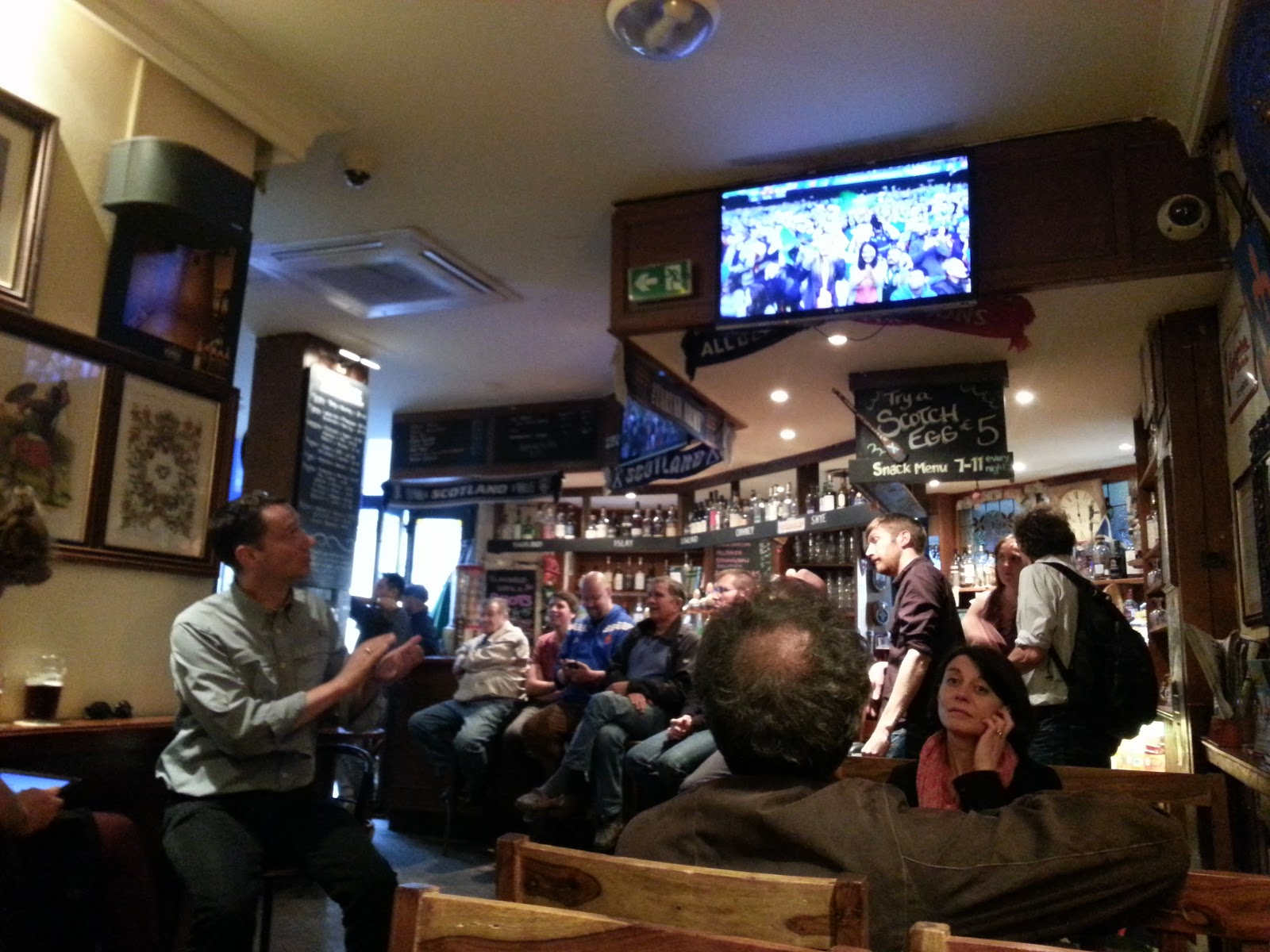
Talia and I cycled down from our flat (where we had contend with cars on the road, how ignoble!) and headed into the centre of the city, where the atmosphere was like that of a public festival. There were street performers, musicians, and a load of people walking and cycling around. We took some time to pop into a Scottish Pub to watch the rugby (which Talia has agreed is a lot more fun to watch than American Football). We were able to see the second half of Scotland's victory over the USA in the Rugby world cup, which was very fun.

Inside the Scottish pub, rugby on the TV.

Paris is normally a very easy city to cycle in, and I'll probably write a post sometime about cycling here. But on the journée sans voiture, it was even easier. With no cars around, no thundering masses of traffic, it was simple and relaxing to bike from place to place. I certainly hope that this becomes a regular Paris tradition.

Nuit blanche

The next weekend, this most recent Saturday was nuit blanche. The name literally means "white night" but it's the French expression for an all-nighter. Here, various public buildings open themselves up to the public, and there are several arts and musical events put on all around the city. The difference here is that it begins at around 7pm, and continues until around 6am!


A short from beneath the Arc de Triomphe.
We found an event we wanted to go to, la Nuit du Quator à l'Orangerie (night of quartets at the Orangerie), a series of string quartet performances in an art gallery surrounded by Monet's paintings of water lilies. It began at 7pm, finished at 6am, and had a different quartet playing each hour. How exciting! However, once we got there, the queue was huge and they were only letting in so many people per hour. There was very little chance that'd we'd get to go in (at least not before 1 or 2am, and we didn't really want to stay out that late), so instead we went for a wander through central Paris. Instead of going to a rugby pub and watching Scotland's defeat at the hands of South Africa, we instead walked up the Champs-Elysée to the Arc de Triomphe, one of the few major Paris monuments that we haven't yet visited. Afterwards, we slowly made our way home, stopping for dessert in a local café. Not the night we had planned, but an extremely enjoyable one nonetheless.
Dessert! This is a café gourmand, a coffee (espresso) with three different miniature desserts to sample.

Free museums

For Americans, the sheer number of free or discounted museums in Paris may seem overwhelming. For Brits too perhaps, although some cities (notably Glasgow) have made a strong commitment to keeping a preponderance of free museums. Notably (and relevant for today's post), there are several museums in Paris which normally charge for entry, but are free on the first Sunday of the month. (There are a few also which are only free on the first Sunday of the month at certain times of the year. For example, The Louvre is free on the first Sunday of the month from October to March.)

Yesterday, the day after nuit blanche, was the first Sunday of the month. Not wanting to squander this opportunity (there are, after all, only 12 first Sundays every year), Talia and I biked down to the Musée des Arts et Métiers. Its name literally means "Museum of Arts and Crafts", but it's basically a museum of science and industry, with exhibits on scientific instruments, materials, energy, mechanics, communication, construction, and transport. Each section takes you on a historical tour from the pre-industrial days (before 1750) up to the modern era.

The outside of the Musée des Arts et Métiers. Yes, that's a converted church on the left.

Although we got in for free, we paid to get a little audio guide, which gives you extra information on each exhibit as you go through. It was well worth it; as well as providing extra background information on some of the more interesting artefacts (such as Clément Ader's steam-powered aircraft), it also provided historical and economic overviews of the importance of particular innovations in industrial processes, such as the use of regenerative heating in blast furnaces, or how precisely a Koenig Sound Analyser works. (The sound analyser pre-dates the oscilloscope, yet allows for frequency decomposition of sound, which is really cool.)

After the tour of the museum, we then visited the nearby Musée Carnavalet, a museum which chronicles the history of Paris. This museum is free all the time! We didn't spend a lot of time there, although we got to see several rooms full of various historical artefacts, and then a large exhibit on the history of the French revolution. The revolution exhibit was very interesting since it held lots of contemporary ephemera from the era - paintings and cartoons, newspaper printings, popular ceramics made to commemorate particular events. Given how rapidly public and political opinion changed between 1789 and 1795, it was fascinating to see those little snapshots of history memorialised for the future.

Finally, on our way home we bumped into another demonstration. Unlike the previous one documented on this blog, this one was in Place de la Bastille and was in support of immigrants and refugees. There were various people there from all sorts of organizations, although sadly no tractors this time. We snapped a few pictures, but you can see some professional ones here.
His sign reads "no person is illegal".

Next weekend

What exciting festival is in store for us next weekend? Thursday the 8th to Monday the 11th is in fact la fête de tournez les taureaux, "the festival of turning bulls". Yes, the Turnbulls are coming to visit - we'll be hosting my parents for a long weekend. If it's anything like the last few weekends, we're in for a treat!

Tuesday, August 18, 2015

Cello Reunited

Our lost luggage saga wasn't wrapped up as neatly as we had hoped. As we mentioned in a previous post, the flights to Scotland were lovely and everything was perfect until we arrived in Glasgow and found that none of our luggage had arrived, including my cello. After much calling and wrangling with the airport courier service, we got back three of our suitcases two days after we arrived--just in time for the wedding we were attending. Phew!

Except...conspicuously absent from the luggage delivery was the one thing I couldn't live without: my cello. They didn't even know that they were supposed to look for a cello in addition to the three suitcases despite us saying very clearly to the contrary. I mean, how do you lose a cello!? It pretty obviously stands out.

I was fretting and grumpy for the next two days, worrying about where my baby could possibly be. Eventually, they managed to find it and they sent it down to Rory's parents' house, but I was on my journey in the Highlands and then to Glasgow at the time, so I didn't get to see my cello for another week.

At last, I was reunited with my cello--something that is only slightly less valuable to me than my marriage. As I opened the case, I was praying that all the extra handling and shipping hadn't damaged it. TSA agents are seemingly unable to open a cello case, inspect it, and close it without leaving something unlatched. This was no exception. My bow had not been fastened and was hitting the instrument for the whole journey. But luckily, it was still in perfect shape and I was able to tune it and play it happily for the next hour.

I was feeling emotional about having my instrument back and about coming to the end of our stay in Scotland, so I composed a short quasi-Scottish sounding tune and took a video of it. Rory's dad called it the "Icelandair Lament". Here it is!