Showing posts with label explore. Show all posts

Monday, April 3, 2017

Château de malmaison

Two weeks ago, March 20th, was Naw-Ruz, the Baha'i New Year. I took the day off work and we decided to go on a short day trip to welcome in the new year. The weather was pleasant -- bright but cloudy, dry and reasonably warm. It was a welcome change from winter.
The château de malmaison.
We settled on visiting the Château de Malmaison, the former residence of Empress Josephine, Napoleon's first wife. This is in the suburb Rueil-Malmaison, a short train or bus ride west of Paris.

If you know some French, you probably realized that "Malmaison" sounds like "bad house": mal means bad or wrong (like in the English words maladjusted and malnutrition), and maison means house. Sometimes when you see curious expressions like this in place names, it's actually a coincidence, and the name originates with some other words, perhaps words which are now archaic or forgotten, or even from a different language. For example, the names of the English towns of Puddletown and Catbrain are actually derived from Middle English phrases meaning "farmstead on the marsh" and "soil mixed with clay and stones", respectively.

In the case of Malmaison, however, it really does have the meaning we think. In 846, a mansion in this area was burned to the ground by Viking invaders. The area was then dubbed malmaison, meaning "mansion of back luck". Looks like the name stuck!

On the way to the chateau, we bumped into the parc de l'amitié, the park of friendship, a local park with some Japanese gardens, a rose garden, and some other features. Given the name and the Japanese theme, I thought that perhaps it was a garden of international friendship -- perhaps the results of the town being twinned with somewhere in Japan, or something like that. But I was unable to find any evidence of that. As far as I can tell, the city planners just wanted to build a cool park. That's okay with me!

The Japanese garden featured a pond and a scenic bridge. And blossoms, lots of blossoms.
In the grounds of the chateau itself is an art collection of Daniel Iffla, a 19th-Century French financier and philanthropist who named himself Osiris (yes, the same name as the Egyptian god). It was a modest collection of various objets d'art from various cultures around the world -- China, Persia, Greece, Rome. It was also really dark inside (presumably to protect the art), and quiet. It doubled as a good place to quickly change and feed Maëlys, too.
Osiris himself!
It was lunchtime when we arrived, and the chateau closes for lunch! The gardens were still open, however, so that afforded us some time to enjoy our own lunch (we'd packed a little picnic) and look around. The gardens are home to a large rose garden, not in bloom at the time of our visit, and several statues and little streams dot the area. Attempts have been made to have the garden resemble how it was at the time of Empress Josephine, although in her day the gardens extended much further in all directions. Josephine grew up in Martinique, in the Caribbean, and so apparently having a well-tended, diverse garden was a particular source of joy for her. There used to be a greenhouse where she grew pineapples!

One of the garden paths, with the chateau in the distance.

As you can see in the picture at the beginning of this post, it is a nice building, but not particularly grand. That is, it is an excellent example of a stately home, but if you had asked me to guess who lived inside, I would not have imagined "empress". The reason for that is because Josephine purchased the mansion way back when Napoleon was just a general, busy invading Egypt. When Napoleon returned, apparently he was upset at her for purchasing such a run-down mansion that would require so much work to renovate! He didn't have much time to be angry, however, as he was busy planning a coup d'état to overthrow the unpopular government and install himself as emperor. They divorced in 1810 following acrimonious disputes about affairs and Josephine's infertility, although she remained Empress.

Anyway, the inside of the chateau was decked out as it was at the time of Josephine. There were lots of grand paintings, intricate timepieces, and fancy chairs. Absent was any kitchen or obvious servant's quarters, but apparently they were in other buildings in the grounds which have since been destroyed.

One of the receiving rooms inside the chateau.
There was a lot of Napoleon-themed pieces around, including the original version of the famous painting Napoleon Crosses the Alps, which depicts (in grand heroic style) Napoleon heading from France into Italy in 1800. Not pictured: his army!

Napoleon Crosses the Alps!
After we'd seen around the chateau, we hopped back on a bus and then a train and made our way home. It was a lovely trip outside of Paris for the day, and we're going to try to do more day trips like this as our move to Hawai'i gets closer and closer! As I looking back on the pictures from the chateau, it all looks a little drab and grey in comparison to the weather we've had here in the last week or so. It appears that we did a good job of welcoming in the spring!

Monday, February 29, 2016

On the road to Rouen

(Title of this post shamelessly stolen from the Supergrass album of the same name. And yeah, we took the train, so it's not even that accurate.)

Last weekend, we took a short trip to Rouen - we left Paris on Friday afternoon and came back on Sunday afternoon. Rouen is a small city northwest of Paris, about 75 minutes by train. It's the capital of Normandy and is principally famous as having several medieval cathedrals and also as being the place where Joan of Arc was tried and executed. For us, it was a chance to get out of the hustle and bustle of Paris and have a relaxing weekend. For Talia in particular, it was her first time exploring France outside of the Île-de-France region.

The journey begins.
I didn't know that much about Joan of Arc before going to Rouen, so here's a rough approximation of my knowledge. The background to the story is the Hundred Year's War between France and England, which despite the name, did not last for a hundred years (it was 116 years), and was not a war (it was a series of disconnected skirmishes and battles). During this period, the English crown was trying to assert authority over (parts of) France, while (parts of) the French royal family were fighting to oppose it. Joan of Arc was a peasant girl who had a number of religious visions showing a united France, and rose to prominence in leading successful attacks in several decisive battles. (To do this, she wore men's clothes, which was regarded with a mixture of shock and bemusement.) After a while, she was captured by the English (well, allies of the English in any case), and eventually put to death (by burning) for heresy. Given that Joan quickly became an icon of French culture, a symbol of fighting for freedom against an oppressive force*, the town that was responsible for putting her to death has been, at time, a little embarrassed of its status.

[* This is part of the myth-making that I don't really understand. It wasn't as if France was under the cruel yoke of a dictator and they were fighting for freedom and democracy. This was a war to determine which unelected hereditary leader was "rightfully" the leader of France. Not particularly noble in either case.]

Nevertheless, there are a number of Joan-related activities that you can do. Principally, you can visit the 13th-century fort where she was imprisoned.
The fort where Joan of Arc was held prior to her execution.

Rouen recently made most (all?) of their public museums free of charge. Consequently, we had the following exchange at the entrance to the fort:

Man: Entry is free. Well, except for the English. You're not English are you?
Talia: No, I'm American, and he is Scottish.
Man: Ah! American! Well, you liberated us, so you can go in. And Scottish? My grandmother was Scottish, so you're good too.

(Of course, he was ignoring the fact that the Scots fought on the side of the French in the Hundred Years War, including the fact that several Scottish soldiers fought alongside Joan of Arc during the siege of Orléans.)

Once inside, there was a good selection of historical information and Jean-related paraphernalia. One exhibit featured an amusing Franglish translation:

Her "eldbows"; she is "hearing the voices"; "made in biscuit".
The statuette in question. Looks delicious!
This post would be remiss if I neglected to include pictures of the grand churches and cathedrals. It felt like you couldn't go a few paces without bumping into another huge church or medieval tower.


The trip achieved its goal of being a relaxing (yet cultured) weekend away. There are many more regions of France to explore, so hopefully this will be the first of many such excursions!

Sunday, December 6, 2015

New Zealand, part 3

We're back in Paris safe and sound now, but we still have a lot of pictures and New Zealand-related stories to share. Here are a few of them.

(See parts 1 and 2 of our journey to New Zealand, and Talia's writing.)

In case you forgot the backstory, I was invited to the University of Canterbury by a former colleague to finish up a linguistics project we've had going for several years. It had stalled and delayed, but setting aside some time to work together intensely on the project was a fantastic idea. This arrangement meant that I was working at the university most of the time, with free weekends to travel, while Talia amused herself around Christchurch and other places.

You may have heard of Christchurch as being the location of a devastating series of earthquakes in 2010 and 2011. Around 185 people died, and the historic centre of the city lost over a third of its buildings. The effects of the earthquake still loom large in the city. The centre of the town was basically closed for over a year, while workers destroyed the damaged and dangerous buildings. Many of the eastern suburbs, built on marshland, underwent liquefaction and became uninhabitable. The consequent loss of homes, plus the influx of aid and construction workers, lead to a housing crisis. The city is still rebuilding, and even now there is construction all over the place.
The current state of the Christchurch Cathedral.
One of the first weekend trips we took was out to Akaroa, a beautiful seaside town on the Banks peninsula. Akaroa has a curious history - it was originally settled by French colonists. In 1840, the Treaty of Waitangi was signed, which established all of New Zealand as being under British sovereignty. A few weeks later, with news of the treaty not having reached Europe, a group of French colonists (and a few Germans) set sail for New Zealand, hoping to establish an outcrop of the French Empire. When they arrived, 5 months later(!), they learned the islands were now British. They decided to stay anyway, and form a little French village.
The local butcher's shop.

Today, the village is very proud of its French heritage, with the French tricolour flying all over the place. I think they also play up the French connection as a tourist attraction, a quaint little slice of France on the other side of the world. We actually heard a lot of French being spoken, too, but it was all from tourists. The main vestige of the French origins of the town is in the street names.
It's like we're back in Paris!
The Banks peninsula, where Akaroa is, was formed by a series of volcanoes, and has very dramatic hills right beside the sea, leading to a beautiful landscape. The gentle turquoise colour of the sea also adds a lot. It's easy to see why this is a popular holiday destination for Kiwis, and why so many people have second homes here!
The view from the top of the Akaroa lighthouse.

After our trip to Akaroa, Talia went to visit Dunedin, the south island's second largest city, often called "the Edinburgh of the South" for its strong Scottish connections. I'll let her write that post in the future.

Finally, we took a trip out to the west coast. This involves driving through the Southern Alps to emerge at the rainforested area on the other side. The mountains act as a rain trap, apparently, keeping the west coast very wet and the area east of the mountains relatively dry. Our first stop, in the foothills of the mountain range, was Castle Hill, a set of large limestone boulders arrayed around some hills, which from a distance resemble a ruined castle. The area of is of spiritual significance to the Maori, and apparently the Dalai Lama referred to it as the "spiritual centre of the universe".
Limestone rocks.
On our way through the mountains, we were lucky to spot a wild Kea. These endangered birds, unique to New Zealand's south island, are the world's only alpine parrot.
You can't see it in this picture, but it's actually perched atop an informative sign saying "Protect our Keas!" with information on their habitat and instructions not to feed or disturb them.
We finally reached the west coast, greeted by roaring waves (really really big waves) and a beautiful sunset.
Getting close as we are to the southern hemisphere summer solstice, this picture was taken at about 9:40pm.

The next day, we visited the Pancake Rocks, named because they look like stacks of pancakes. The ocean runs around and through these rocks, leading to some "blowholes" where water just bursts up into the air from a surging wave. It's really very spectacular.
No maple syrup, unfortunately.
 Later that day we made our way back to Christchurch. The rain prevented us from getting good pictures of the mountains, but I'm fairly sure they were still there.

The pictures we've shown here have been mainly of the landscape, but the people and culture of New Zealand are very agreeable too. They're very friendly and in no danger of taking themselves too seriously, which I think is by virtue of being rather a sparsely populated country, like Scotland. There also appears to be a lack of regard for traditional barriers like class and religion - people are people - that reminded me of some of the attributes I like about the USA. Still, it's not reducible down to simply attributes of other cultures; New Zealand culture is fiercely unique and it's clear that they are proud to be who they are, living in a beautiful country in the south Pacific.

Thursday, November 19, 2015

New Zealand, Part 2

See part 1 of our journey to New Zealand!

We have lots of pictures of our travels in New Zealand. I'll let them do most of the talking.

Our "base of operations" in New Zealand is Christchurch, the largest city on the south island. Before leaving on our trip up the east coast, we explored the city's botanic gardens.

A Californian redwood, with ivy climbing up it! These trees aren't native to New Zealand but they've been introduced.
A flower of some variety.
Coffee! As a former British colony, tea is very popular in New Zealand, but the most recent gourmet coffee revolution begin in nearby Australia, and there's a thriving coffee culture here. Excellent espresso abounds.
 We rented a car and drove north along the east coast to the seaside town of Kaikoura. This area is notable for being close to a mountain range, a large bay with lots of marine mammals, and several seal colonies.

This is a seal.
Talia and Rory. Not native to New Zealand.
There are some seals on the beach waaay in the distance.
A lot of the landscape reminded me of Scotland. And of Oregon, too. It was an interesting combination, with the sea, the beaches, the cliffs, the mountains. A lovely place to be. There is also a fairly large set of businesses that will take you out on whale-watching tours, or to swim with (wild!) dolphins or seals. But there is something more special (and cheaper) just up the road from Kaikoura. Close to a seal colony, there's a waterfall which leads to a large pool. The seal pups trek up from the beach and go to the pool to play and learn to swim.

Click the picture to see it bigger. It's a little blurry, but there are several baby seals playing in the water here.
A clearer picture of two of the seals.
Our next stop was Picton, a northerly village where you can catch a ferry to the north island. It's right by the Marlborough Sounds, a network of sunken valleys with lots of winding water paths. Very wild and great to explore. We took a little boat tour around the area, stopping at a few places.

Clouds! The Maori name for New Zealand is Aotearoa, which is thought to derive from a phrase meaning "land of the long white cloud".
Little penguins! Yes, that's the actual name of this species, also known as "blue penguins" and "fairy penguins". These guys are only found in Australia and New Zealand. The ones in this picture are inside of a nesting box on a nature reserve.
A carved pouwhenua, similar to a totem pole, erected at the site of Captain Cook's first landing on New Zealand. Cook was one of the first Europeans to visit New Zealand. This pouwhenua depicts Kupe, the mythical Maori hero who discovered New Zealand, and a giant octopus.
After Picton, we headed southwest, passing through a national park.

Lake Rotoiti.

Us at Lake Rotoiti.
The Maruia Falls
 Continuing over and through a high mountain pass (where we experienced rain and hail), we came to Hanmer Springs, a popular holiday destination noted for its skiing (in winter, of course) and its hot springs.

Hanmer Springs! Talia called this "ridiculously picturesque".
We saw this happy little tree in the forest near Hanmer Springs.
A male chaffinch. Not native to New Zealand, but fairly widespread (and friendly).

On the way out of Hanmer Springs you pass this beautiful turquoise river. If you like, you can do bungee jumping here too!
Then, back to Christchurch. Such a beautiful country! We've only scratched the surface here. There's so much of the south island we haven't even seen, not to mention the north island. There's a lot to explore here, and we don't have time for it all. Still, everything so far has been amazing, so it's hard to complain!

Saturday, October 17, 2015

A weekend in Paris

My mum and dad came to visit us last weekend, which was fun. We got to experience four people living in our little flat (which is not as bad as you might think!), and see some parts of Paris that we hadn't seen before.
All four of us at the Sacre Coeur basilica in Montmartre.
They brought with them several goodies for us, such as Tunnock's Caramel Wafers, and a camera which Talia bought me as a gift. (It was easier to get it posted to my parents' house than to here.) There was also a copy of the newspaper Le Figaro. I've been reading the free newspaper Direct Matin, which I can get on the metro, and I can understand most articles fairly well. However, Le Figaro is apparently written for a more discerning audience (one that actually pays for their news, I suppose), and the language is a lot more impenetrable. My language skills still have a long way to go, it seems.

Foremost among the gifts was a gargantuan quilt my mum made for us. It is very large (sized for a king-sized bed) with various designs - one side for Talia and the other side for me. I'm not doing a very good job of explaining it, and I don't have a photo (yet!), so you'll just have to trust me that it's really amazing. And super warm! Which will come in handy as it has been getting colder and colder here in Paris, it was only about 8C yesterday (that's 46F for you Americans).

The visit was quite lovely. We went to some famous sights, and some not-so-famous sites. We were able to catch a string quartet performance in the middle of our sightseeing, which was a pleasant break in quite elegant surroundings.
Apparently this big pointy antenna is quite famous?
I forget what it's called.
The Quatuor Arod (Arod Quartet) playing in the Hôtel des Invalides. Yes, that is a Hyacinthe Rigaud painting of the sun-king, Louis XIV, in the background.
We also took a trip to the Parc des Buttes Chaumont, one of Paris's larger (yet less touristy) public parks. It's a hilly area, and much more like a natural space than some of Paris's more Victorian parks (I'm looking at you, Jardin du Luxembourg). There are trees, waterfalls, and a little lake with an island. On the island is the Temple de la Sibylle, a miniature replica of a Roman temple. I don't know why they built it, but it certainly lends the area a subdued neoclassical elegance. This is one park I am looking forward to returning to!
One of the waterfalls at the Parc des Buttes Chaumont.
The Temple de la Sibylle.
Being in the position of "locals" showing my parents around Paris was interesting. It was a gentle reminder to me and Talia that we do actually know a lot about how to get around here, what to do, what not to do, and so on, despite our occasional feelings of inadequacy or overwhelmedness. Paris is big, and living in a foreign country is (still) scary, but we're getting the hang of it.

More generally, it was great to have my parents come to visit for the weekend, and it's so much easier for them to come over than when we lived in the US. I was remarking the other day how strange it is to see them so often, and also for so short periods. When we lived in the USA, we would see them for one or two weeks at a time, once a year. Now, the visits are much shorter, but much more frequent. And who could refuse a weekend in Paris?

Sunday, October 4, 2015

Weekend festivals

The French do seem to love a good festival. It seems that every weekend is full of some exciting public event. Here's a rundown of what we've been up to in the last few weekends.

Journées du patrimoine

The journées du patrimoine ("days of heritage") are actually a Europe-wide program, a celebration of culture and history. This manifests itself in various talks and events, but principally in that many public buildings and museums open their doors for people to come inside and have a look around. You can visit the Senate, the Italian Embassy, or even see behind-the-scenes at the Métro stations. This year's heritage days were three weekends ago, the 19th and 20th of September. We knew that it was coming up, but I must confess that we had just forgotten about it and neglected to go anywhere interesting! Still, it didn't stop scores of French people from having a relaxed and culturally enlightening weekend.

Journée sans voiture

The Sunday of the following weekend was the journée sans voiture ("day without cars"), a new experiment in Paris where cars were banned from the streets. The ban was only applied in some of the central arrondisements, and buses and taxis were still able to drive around, although there were a few streets where vehicles were banned entirely. You can see some before-and-after videos here.

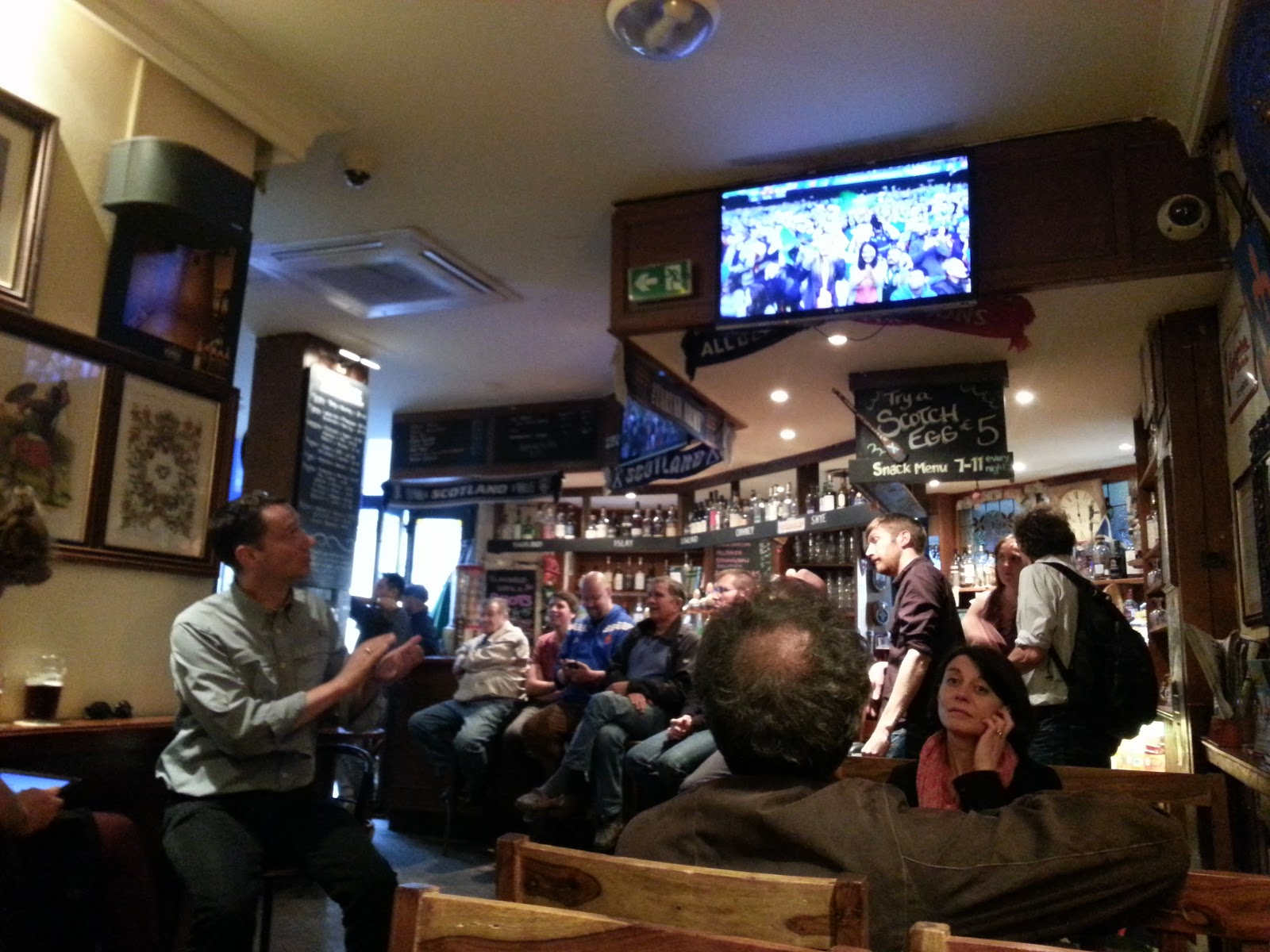
Talia and I cycled down from our flat (where we had contend with cars on the road, how ignoble!) and headed into the centre of the city, where the atmosphere was like that of a public festival. There were street performers, musicians, and a load of people walking and cycling around. We took some time to pop into a Scottish Pub to watch the rugby (which Talia has agreed is a lot more fun to watch than American Football). We were able to see the second half of Scotland's victory over the USA in the Rugby world cup, which was very fun.

Inside the Scottish pub, rugby on the TV.

Paris is normally a very easy city to cycle in, and I'll probably write a post sometime about cycling here. But on the journée sans voiture, it was even easier. With no cars around, no thundering masses of traffic, it was simple and relaxing to bike from place to place. I certainly hope that this becomes a regular Paris tradition.

Nuit blanche

The next weekend, this most recent Saturday was nuit blanche. The name literally means "white night" but it's the French expression for an all-nighter. Here, various public buildings open themselves up to the public, and there are several arts and musical events put on all around the city. The difference here is that it begins at around 7pm, and continues until around 6am!


A short from beneath the Arc de Triomphe.
We found an event we wanted to go to, la Nuit du Quator à l'Orangerie (night of quartets at the Orangerie), a series of string quartet performances in an art gallery surrounded by Monet's paintings of water lilies. It began at 7pm, finished at 6am, and had a different quartet playing each hour. How exciting! However, once we got there, the queue was huge and they were only letting in so many people per hour. There was very little chance that'd we'd get to go in (at least not before 1 or 2am, and we didn't really want to stay out that late), so instead we went for a wander through central Paris. Instead of going to a rugby pub and watching Scotland's defeat at the hands of South Africa, we instead walked up the Champs-Elysée to the Arc de Triomphe, one of the few major Paris monuments that we haven't yet visited. Afterwards, we slowly made our way home, stopping for dessert in a local café. Not the night we had planned, but an extremely enjoyable one nonetheless.
Dessert! This is a café gourmand, a coffee (espresso) with three different miniature desserts to sample.

Free museums

For Americans, the sheer number of free or discounted museums in Paris may seem overwhelming. For Brits too perhaps, although some cities (notably Glasgow) have made a strong commitment to keeping a preponderance of free museums. Notably (and relevant for today's post), there are several museums in Paris which normally charge for entry, but are free on the first Sunday of the month. (There are a few also which are only free on the first Sunday of the month at certain times of the year. For example, The Louvre is free on the first Sunday of the month from October to March.)

Yesterday, the day after nuit blanche, was the first Sunday of the month. Not wanting to squander this opportunity (there are, after all, only 12 first Sundays every year), Talia and I biked down to the Musée des Arts et Métiers. Its name literally means "Museum of Arts and Crafts", but it's basically a museum of science and industry, with exhibits on scientific instruments, materials, energy, mechanics, communication, construction, and transport. Each section takes you on a historical tour from the pre-industrial days (before 1750) up to the modern era.

The outside of the Musée des Arts et Métiers. Yes, that's a converted church on the left.

Although we got in for free, we paid to get a little audio guide, which gives you extra information on each exhibit as you go through. It was well worth it; as well as providing extra background information on some of the more interesting artefacts (such as Clément Ader's steam-powered aircraft), it also provided historical and economic overviews of the importance of particular innovations in industrial processes, such as the use of regenerative heating in blast furnaces, or how precisely a Koenig Sound Analyser works. (The sound analyser pre-dates the oscilloscope, yet allows for frequency decomposition of sound, which is really cool.)

After the tour of the museum, we then visited the nearby Musée Carnavalet, a museum which chronicles the history of Paris. This museum is free all the time! We didn't spend a lot of time there, although we got to see several rooms full of various historical artefacts, and then a large exhibit on the history of the French revolution. The revolution exhibit was very interesting since it held lots of contemporary ephemera from the era - paintings and cartoons, newspaper printings, popular ceramics made to commemorate particular events. Given how rapidly public and political opinion changed between 1789 and 1795, it was fascinating to see those little snapshots of history memorialised for the future.

Finally, on our way home we bumped into another demonstration. Unlike the previous one documented on this blog, this one was in Place de la Bastille and was in support of immigrants and refugees. There were various people there from all sorts of organizations, although sadly no tractors this time. We snapped a few pictures, but you can see some professional ones here.
His sign reads "no person is illegal".

Next weekend

What exciting festival is in store for us next weekend? Thursday the 8th to Monday the 11th is in fact la fête de tournez les taureaux, "the festival of turning bulls". Yes, the Turnbulls are coming to visit - we'll be hosting my parents for a long weekend. If it's anything like the last few weekends, we're in for a treat!