America is a car-centered society. We bought a car within a week
of moving to Honolulu because we realized how necessary it would be
to get around. In our two years of living in Paris, on the other
hand, we took less than a dozen car rides, usually in taxis. Very few
of the people we knew there owned a car, most preferring simply to
walk and take public transit. Parisian public transportation may be
grimy and congested at times, but tickets are cheap, service is
punctual, and stations are everywhere. With the high cost of fuel and
the absurdly expensive and difficult process of acquiring a French
driver's license, for many people, public transit makes much more
sense than car ownership.
Furthermore, Paris engenders a culture of walking. Everyone walks
to the shops, to their dentist appointments, to pick up their
children from school. Most neighborhoods have several grocery stores
within a ten minute walk—I can think of at least eight near our old
apartment. I mentioned in a previous post the three separate free
medical clinics for mothers and children in walking distance of our
home. I even knew women in Paris who walked home from the hospital
after giving birth. With almost every amenity one needs so
conveniently located, walking is often the logical choice. It became
such a regular part of my daily routine that I thought nothing of
spending a few hours on my feet each day, both for getting from place
to place but also for enjoyment, exercise, and relaxation.
Maëlys certainly enjoys walking in Hawaii.
So I find it continually surprising how few people I see walking
in Honolulu. Here, despite the year-round nice weather, it seems that
most people only walk if they have to. For many people, stores,
restaurants, medical facilities, and other necessities are too far
away to walk to or are inaccessible by public transport. There are
often no sidewalks on residential streets, confirming the dominance
of vehicles over pedestrians. And while Honolulu has an excellent bus
system that covers the whole island, I would bet that a majority of
residents have never ridden the bus or have used it only a few times
in a given year. Sadly, I must include myself in that category, as I
have not yet tried out the bus system (though Rory and Maëlys have made one bus trip so far and it is on my list of things to do).
The funny thing is, it only took two years of living in France to
completely change my perspective on the dominance of cars. Before
moving to France, I viewed my car as more than just a way to get
around town; it was my own private refuge. I enjoyed being in the
car, listening to the radio. And if I had to walk for more than five
minutes to get somewhere, I would usually just hop in the car
instead. I don't think I was particularly lazy, nor was I unconcerned
with the environmental impact of driving. But my perception of what
was an acceptable walking distance was skewed. I had no sense of how
far away places were except in terms of driving time, so walking
typically felt like an unnecessary and inefficient use of my time.
After living in Paris, I now much prefer to walk rather than
drive. The fact that a place is far enough away that I must drive to
get there is now a deterrent for me going there. But alas, my options
here are limited when it comes to stores, restaurants, medical
facilities, and schools that are within walking distance of home, so
I feel myself being pulled back into the habit of driving that I so
easily gave up in Paris. Honolulu does have buses and a new bike
sharing program, but service is relatively limited, and the
convenience factor is far less than simply jumping in a car. So for
now, to combat the influences of America's ever-present car culture,
I'm trying to patronize the few stores that are located near our home
(walking there, of course), take daily walks around our neighborhood,
and avoid unnecessary trips in the car. And one of these days, I'll
have to try out the bus.
In case you haven't heard, the baby has arrived! Little Maëlys joined us two weeks ago today. She is approximately the same size as a small otter.
She does not appear to swim as well as an otter, though, or enjoy raw clams.
Maëlys and Talia were both healthy and happy after the birth. As is standard in France, they stayed in hospital for 3 nights after the birth. In the UK and USA, usually you leave the hospital within a day or so, and only stay longer if there's a problem. Here, they routinely keep you until the baby has begun to gain weight. Having nurses and midwives around who can answer questions or provide assistance - even in the middle of the night - is a very reassuring way to ease into parenting, especially when we're all learning new skills such as changing nappies, or breastfeeding.
All set to go home!
Once we had been cleared to go home, we loaded her into our little car seat and drove her home in an electric car.
A week ago, she was a week old.
Today, she is two weeks old.
Both my parents and Talia's parents came all the way to Paris to meet their new granddaughter, and to share with us their love, support, and advice. I can't think of a better way to transition into parenthood! They left just a few days ago, leaving us to raise this critter all on our own. Wish us luck!
Paris has an excellent metro system, which moves 4 million people a day. There's also an extensive bus and larger commuter train service. More recently, however, the city officials have been trying to encourage more cycling, partly to reduce traffic congestion (of which there is a lot), and to improve health and well-being. This means that recently there have been a number of bike-friendly changes to the road infrastructure. There are several bike lanes, of various degrees of separation from the traffic, and also bikes are able to share the bus-and-taxi lanes. Several one-way streets are actually two-way for bikes, which makes navigation easier, and at some traffic lights there are signs indicating that bikes can proceed (either forward or to the right) at a red light, if the coast is clear. On Sundays and public holidays, some roads near the centre of town are closed to all non-bike non-pedestrian traffic. And there was the journée sans voiture, when cars were banned from the city centre. Still, even with those bike-friendly policies, surely it's a terrifying notion to go out onto the road with wild Frenchmen? After all, tourists (Brits and Americans alike) return with crazy stories about the frenetic, chaotic traffic in Paris. And there is video proof!
Well, I've been cycling to work more or less since I began in September, and I can tell you: Paris is a joy to cycle in. Outside of Amsterdam, I can't think of a large city that I would rather cycle in. Let me explain why.
Other cyclists
First of all, strength in numbers. It's much easier to brave the streets when there's a whole gang of cyclists you're moving with than when you're on your own. On my way to work, I routinely cycle with at least one or two other cyclists who happen to be going the same way at about the same speed. Total strangers, but we stick together on the road and feel safer. On the way back it's not uncommon to see about half a dozen others, especially on the busier roads. This feature isn't unique to Paris, of course, but it makes cycling easier, especially for a relative novice like myself.
Other road users
The first thing to understand about the traffic in Paris (and many other large European cities like Rome) is the preponderance of motorized scooters and small motorbikes. They are everywhere, and they zip around everyone. They go in bike lanes, bus lanes, they jump red lights, they'll even go on the pavement (sidewalk, for the American readers) to get around an obstacle. This is not to say that it's totally anarchic - I'm definitely over-emphasizing their wildness - but simply that these motorbikes are an established part of the Parisian traffic.
From the perspective of a car driver, then, a bicycle is just a smaller, slower, more timid moped. The car drivers are used to looking out for mopeds, checking their blind spots, being conscious of allowing them to filter through traffic. As a consequence, they're very conscientious of bikes. There have been several times, when I move past a line of stopped cars to get to the front at a red light, that a car has actually moved slightly to give me more space to get past. I've almost never seen that happen in the US or the UK.
Another thing to understand about Paris traffic is something that sounds quite obvious - the laws are different here. The rules of the road, and of who has right of way, are quite different to those of the US and UK (and quite unintuitive if you were raised in either of those systems). While Brits may think the French traffic to be chaotic, the French think British traffic is inflexible. There have been maybe three times when I have misunderstood the rules of the road and turned when I didn't have right of way, and so on. Each time, rather than tooting their horn and yelling at me, car drivers have slowed and allowed me to pass, even though they had every right to continue. It seems that bike-riders are extended some courtesy - even excessive courtesy - which is perhaps not extended to other car drivers.
The Velib' system
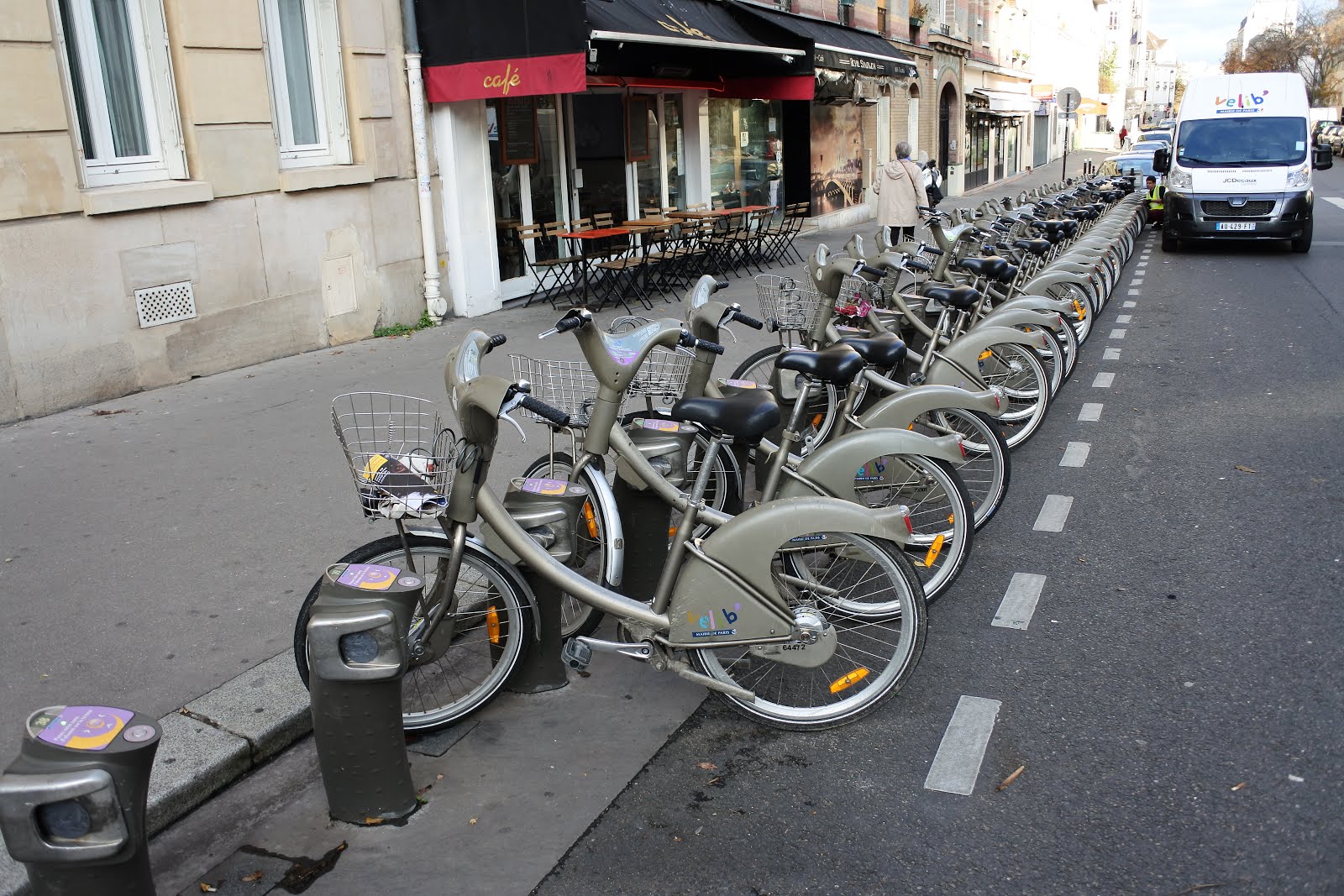
Paris has a bike-share system called Velib' (a blend of vélo "bike" and liberté "freedom"). There are similar systems in many other cities you may be familiar with (like Toronto, Columbus, London, and others). In case you're not familiar, here's a brief explanation of how it works:
A bike station with some attached bikes.
There are bike stations all over the city, each with several bikes attached. You scan your card on the bike stand of the bike you want, and the bike is released and you can take it. When you're finished, just park it back at any other bike station, and you're good.
The bike is free for the first thirty minutes, and after that you pay a small amount per half hour. There is also a subscription cost - 1.70€ for a day, 8€ for a week, or 29€ for a year. Yes, a year's subscription at only 29€, which gives you free half-hour bike rentals. Much cheaper than buying and maintaining your own bike.
The cupboard was bare!
It's possible that when you go to return the bike, the station is full. Or that when you want a bike, the station is empty. Luckily, there are stations everywhere. There are over 1,000 stations, and over 30,000 bikes, in the entire system. It's the largest bike-share system outside of China.
The bikes are of varying quality. Sometimes the brakes are iffy, or there's a punctured tyre or broken chain. Thankfully, an informal system has sprung up where if someone notices if a bike is bad, they turn the seat to face backwards. That way it's easy to see at a glance if a bike is suitable. I've had a few duds but mostly the bikes are good, and the stations are so common it's easy to drop off a bad bike and exchange it for another.
My route to work
Finally the last reason that cycling in Paris is so enjoyable is the reason that many things in Paris are enjoyable - it's Paris! Every day on my way to work I get to see the Notre Dame, (a glimpse of) the Eiffel Tower, the Place de la Bastille, the Pitié-Salpêtrière Hospital, the Jardin des Plantes, the Grand Mosque of Paris, and many other sights. It's very exciting!
Cycling is Paris is not as scary as it may seem at first, and there's lots of ways that it's been made more pleasurable than it could be. I definitely enjoy having the freedom to cycle around, rather than having to be squeezed into a metro train or a bus. If you come to Paris, let me take you out cycling :-)